
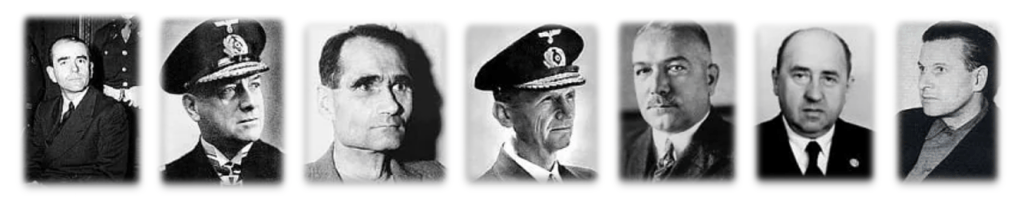
Following the main International Military Tribunal (IMT) at Nuremberg, the seven convicted Nazi leaders sentenced to prison terms (including Rudolf Hess, Albert Speer, and Karl Dönitz) were transferred to Spandau Prison in West Berlin under a strict, four-power joint administration (the US, UK, France, and USSR). Procedures for handling prisoner affairs were arrived at by all four parties, but prisoner oversight wasn’t always carried out to the letter of the law. By late 1948 (in the middle of the Berlin Blockade), the Soviets saw that the US had introduced a number of changes to the regime that they felt was too lenient on the war criminals.
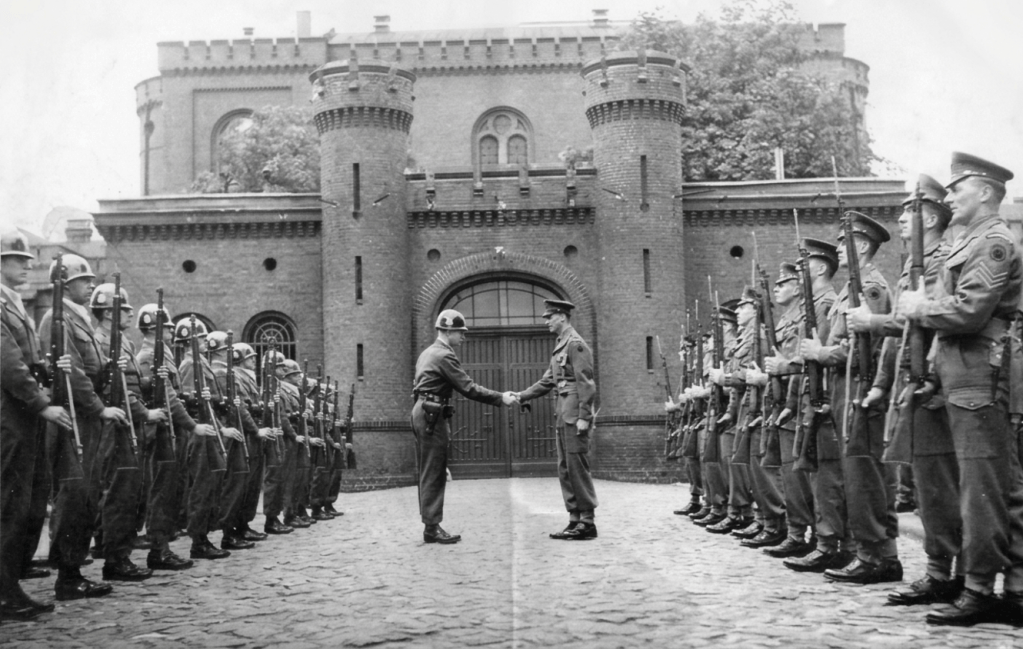
The prisoners initially arrived at Spandau on July 18, 1947. Toni Howard, an American correspondent for Newsweek, the first person granted permission to enter the facility and speak with its staff, described the prison on the outskirts of the British sector of Berlin as follows: “A 16th-century fortress. Double steel doors, gray in color. Four guards, each armed with a carbine, representing the four Allied powers. The prison itself is a brick structure of unusual design; it resembles a massive hospital—a long, multi-story, cross-shaped building with four wings. The ‘seven clients,’ as the American guards called them, occupied cells in a largely empty wing, the one furthest from the fortress entrance. The rest of the prison stood vacant. Day and night, they were monitored by an unarmed civilian guard force of 32 people, eight from each of the occupying powers. When doctors arrived for examinations, they came in a group of four. All letters addressed to the prisoners were subject to censorship.” The inmates were permitted to write and receive two letters every six weeks and were allowed one visitor every two months. They spent eight hours a day working in the courtyard, growing vegetables, and received a diet with a caloric content equivalent to that of German laborers. They were granted access to a library, allowed to shower daily, and were shaved every day by a barber (AVP RF, F. 82, Op. 29, P. 96, D. 21, L. 33–37).
Western representatives had previously noted that Soviet authorities vehemently opposed medical treatments or surgical intervention proposed by American and British doctors intended to prolong the lives of the aging, ailing prisoners. Western officials openly complained that the Soviets seemed to prefer solving the Spandau problem via the “early demise” of the war criminals. For their part, the Soviets countered by accusing the capitalist Western powers of violating the spirit of the Nuremberg judgments by attempting to institute a lax regime. They used these disputes to claim via propaganda that the U.S. and its allies were never truly serious about denazification.
The following are two Secret reports filed regarding affairs surrounding the handling of the Spandau Seven. The first, dated 21 December 1948, is a Secret memorandum from the Deputy Political Advisor to the Soviet Military Administration in Germany, Georgiy Arkadyev, to Andrey Vyshinsky regarding the detention regime. The second, dated 30 December 1948, was a communication from Major Aleksandr Kotikov, the Military Commandant of Berlin, to the Political Advisor to the Soviet Military Administration in Germany, Vladimir Semenov, regarding a meeting of the directors of the Allied Spandau Prison and the situation within the prison. Neither of the authors of these missives felt that the Soviets were being afforded the respect they felt they deserved.
The first document was drafted on the basis of a report from Colonel A. I. Yelizarov, acting military commandant of the Soviet occupation sector in Berlin, to Lieutenant General Grigoriy Lukyanchenko, Chief of Staff of the Soviet Military Administration in Germany, regarding measures taken by the American military authorities in Spandau. It also noted that a regular meeting of the directors of the Allied Prison took place on December 7, during which the British and French authorities conveyed their affirmative responses to a proposal made by the American representative. Furthermore, it was reported that on December 6, the Allied Prison was visited by [George Price] Hays, Deputy Commander-in-Chief of U.S. Forces in Germany, along with Chief of Staff General Gailey and the commandant of the American sector of Berlin, Howley; they held conversations with each of the prisoners. Attached to Yelizarov’s letter was a “Menu Schedule for the American Month of Chairmanship, dated December 4.” According to this schedule, the prisoners were served the following: for breakfast—milk soup with cereal, 20 g of butter, 25 g of marmalade, sweetened tea, and 200 g of white bread; for lunch—milk soup with cereal, 250 g of white bread, 20 g of butter, and 25 g of marmalade; and for dinner—two meat patties with gravy, mashed potatoes with lard, peas, 20 g of cheese, coffee with sugar, and 250 g of white bread (AVP RF, F. 0457a, Op. 5, P. 32, D. 24, L. 132–136).
Document 1:
[Note that the attachments mentioned in this first of the two documents were not published, possibly suggesting is has yet to meet declassification criteria.]
21 December 1948
SECRET
To the DEPUTY MINISTER OF FOREIGN AFFAIRS OF THE USSR Comrade A.Ya. VYSHINSKY
I hereby report that on December 3, 1948, at a meeting of the directors of the Allied Prison in Spandau, where the major war criminals convicted by the International Military Tribunal are held, the American director, Major [Maxwell] Miller, stated that the American command had ordered the following measures to be carried out at the prison during the month of December 1948 (the month of their chairmanship):
1. Increase the daily caloric intake for prisoners to 2,702 calories, up from the previously established 1,999 calories;
2. Allow prisoners to rest while lying down at any time while they are in their cells;
3. Permit prisoners to converse with one another at designated times, under appropriate supervision;
4. Allow each prisoner one 15-minute visit every two months. This policy may be further relaxed in the future to permit 30-minute visits on a monthly basis;
5. Provide prisoners with suitable indoor work during inclement weather;
6. Offer prisoners appropriate forms of recreation, such as playing horseshoes, etc.;
7. Implement a moderate level of censorship regarding the prisoners’ correspondence, books, and other materials.
Thus, the unilateral action taken by the Americans does not conform to the established Four-Power regime for the serving of the sentences handed down by the International Military Tribunal in Nuremberg in the case of the major war criminals.
It fundamentally alters the conditions and procedures for the prisoners’ confinement and, in effect, rescinds the decisions previously adopted by the Coordinating Committee and the Allied Kommandatura of the city of Berlin.
In light of the above, I wish to inform you that Marshal Sokolovsky has instructed the commandant of Berlin, Colonel Yelizarov, to state to the Americans, the British, and the French that the Soviet side adheres to the four-power agreements regarding the regime within the prison and considers any unilateral actions in this regard to be unlawful.
ATTACHMENTS: 1. Excerpt from the minutes of the 122nd meeting of the Coordinating Committee (KORK/M/47/26) dated May 17, 1947, regarding the statute for the Allied prison in Spandau (3 pages).
2. Menu/ration schedule for the major war criminals for the month under American chairmanship (1 page).
3. Menu/ration schedule for the month under our chairmanship (1 page).
DEPUTY POLITICAL ADVISER TO THE SOVIET MILITARY ADMINISTRATION IN GERMANY
(G. ARKADYEV)
AVP RF. F. 0457a. Op. 5. P. 32. D. 24. L. 146-147.

Document 2:
30 December 1948
SECRET
To the POLITICAL ADVISOR TO THE SOVIET MILITARY ADMINISTRATION IN GERMANY, Comrade V. S. SEMENOV
On December 30, 1948, a scheduled meeting of the prison directors took place at Spandau Allied Prison.
The presiding director (from the USA) reported that a request had been received from Dr. Wolff, the defense attorney for prisoner Neurath, seeking permission to visit his client.
The British representative stated that he had no objection to the visit, as the Legal Committee had already resolved the matter.
The French representative likewise raised no objection to the visit.
The American representative stated that, since the Legal Committee had authorized Dr. Wolff to visit prisoner Neurath, the meeting would take place tomorrow, December 31, at 2:00 p.m., provided that Dr. Wolff arrives at the prison.
The Soviet representative stated that Dr. Wolff’s letter had already been considered by the directors of the Allied prison and that his request had been denied.
As no new circumstances have been presented, there is no need to reconsider the previous decision. At the same time, the Soviet representative asked to which decision of the Legal Committee the prison directors were referring.
The American representative replied that the decision to allow Dr. Wolff to meet with Neurath had been reached during a tripartite meeting of the Legal Committee and that this decision would be carried out. The American representative added that the Soviet representative could be present during the meeting.
With this, the discussion regarding the admission of the lawyer, Dr. Wolff, to see the prisoner Neurath was concluded.
Under “other business,” the American representative raised the issue that a Soviet censor had cut out a significant portion of a letter written by prisoner Neurath to his wife. He added that, since the American, British, and French representatives, all of whom had reviewed the letter, concluded that the Soviet censor had acted improperly, a photocopy of the letter, as originally written by the prisoner, would be sent to his wife.
The Soviet prison director maintained that the Soviet censor had acted correctly and in accordance with the regulations; the letter contained references to Nazi activities, which are prohibited by the Allied prison regulations.
The American representative reiterated that a photocopy of the original letter would be sent to the prisoner Neurath’s wife.
At the end of the meeting, the British representative informed the directors that, by order of the British High Command, the procedures established by the American authorities would remain in effect during the month of the British chairmanship, in the interest of maintaining the prisoners’ health. These procedures will continue until the prisoners’ health has improved.
The meeting was then adjourned. The next meeting is scheduled for January 6, 1949, at 10:00 a.m.
Throughout the month of December, the Americans, who held the chairmanship of the prison, implemented a revised dietary scale for the prisoners, increasing the intake from 1,900 calories to 2,702 calories, and adjusted the prison regime in full accordance with their previous statement.
There is evidence to suggest that the Americans and the British are attempting to provoke the Soviet director or the Soviet guards into a sharp reaction, with the aim of freeing themselves from the four-power administration of the prison starting in March 1949 (the month of the Soviet chairmanship).
Information regarding such discussions among the Allies was provided by German staff members at the Allied prison.
I await your instructions.
MILITARY COMMANDANT OF THE CITY OF BERLIN
MAJOR GENERAL A. KOTIKOV
[Attachment]
ON THE SITUATION THAT HAS DEVELOPED IN THE PRISON FOR MAJOR WAR CRIMINALS CONVICTED BY THE INTERNATIONAL MILITARY TRIBUNAL IN NUREMBERG
Pursuant to Supervisory Council Directive No. 35 of September 7, 1946, a prison was established in Berlin to house major war criminals sentenced by the International Military Tribunal at Nuremberg to life imprisonment or fixed terms of incarceration (Hess, Neurath, Funk, Dönitz, Raeder, Speer, and Schirach).
The prison has been in operation since July 1947. It is located in the British sector of Berlin, in the northwestern part of the city, in the Spandau district. In accordance with decisions made by the Supervisory Council and the Allied Kommandatura, the administration of the prison is quadripartite.
The prison administration and internal guard staff consist of representatives from the USSR, the United States, Great Britain, and France. The prison is headed by four directors, with one representative from each nation.
Internal security is maintained by unarmed guards, with eight guards provided by each nation.
External security for the prison is provided by the four nations on a rotating monthly basis, following the order previously established for the chairmanship of the Allied control bodies. Accordingly, the Soviet side is responsible for external security during the months of March, July, and November.
In terms of personnel, the military unit responsible for external security must consist of at least 54 armed soldiers, NCOs, and officers.
The fundamental provisions regarding the four-power administration of the prison and the regime for the inmates are set forth in the prison charter, which was approved by the Allied Kommandatura on June 10, 1947. The prison was under the authority of the Allied Kommandatura of Berlin.
From the very first days of the prison’s operation, the American delegation to the Allied Kommandatura frequently attempted to revise the prison’s charter in a way that would weaken the four-power control over the facility. Throughout the existence of the Allied Kommandatura, however, these American efforts proved unsuccessful.
After the Allied Kommandatura ceased its operations, leaving the prison as the sole remaining four-power body in Berlin, the Americans began to take unilateral actions within the prison with increasing frequency. More recently, the Western representatives on the prison administration have gone so far as to completely disregard their Soviet counterparts.
When issues are discussed at meetings of the directors, the views of the Soviet representative are ignored; instead, decisions are reached on a tripartite basis and subsequently implemented.
For instance, on December 3, 1948, at a meeting of the prison directors, the American representative, Major Miller, announced that, acting on instructions from the American military command, he would immediately alter the regime established by the charter. Specifically, he intended to increase the prisoners’ caloric intake from 1,999 to 2,702 calories; permit conversations between prisoners (which were prohibited by the charter); allow prisoners to receive visits from relatives and acquaintances more frequently than the charter permitted; relax the censorship of prisoners’ correspondence; and carry out various other measures deemed necessary for the “more humane treatment of prisoners.”
The day after this statement, the previously agreed-upon regime and daily schedule were unilaterally altered by the American prison director, in accordance with his statement and with the concurrence of the British and French representatives.
In response to the Soviet prison director’s protests and his demands for strict adherence to previously agreed-upon decisions, the Western representatives reaffirmed that they would continue to be guided not by the prison regulations, but by instructions from their own superior authorities.
In violation of Section 10 of the prison regulations, American and British guards and prison directors have been engaging in suspicious discussions with the prisoners.
On December 6, 1948, the prison was visited by General Hays, Deputy Commander-in-Chief of U.S. Forces in Germany, and General Gailey, US Chief of Staff in Germany, accompanied by Colonel Howley, the American Commandant of Berlin. During their visit, they spoke with all the prisoners, inquiring about their well-being and health; in the cases of prisoners Dönitz and Neurath, they specifically asked about the whereabouts of their family members.
There is information suggesting that the Americans intend, in the near future, to take steps to transfer the prisoner Neurath to the American zone of occupation—ostensibly to appear before a denazification tribunal.
Given the current situation and the suspicious maneuvering by the Western authorities regarding Germany’s major war criminals, I request your instructions on this matter, as well as guidance on the position we should adopt in March, a period when we will be responsible for providing food for the prison, and when Soviet troops will be tasked with external security.
AVP RF. F. 0457a. Op. 5. P. 32. D. 24. L. 150—154.

Translation © 2026 by Michael Estes and TranslatingHistory.org

