
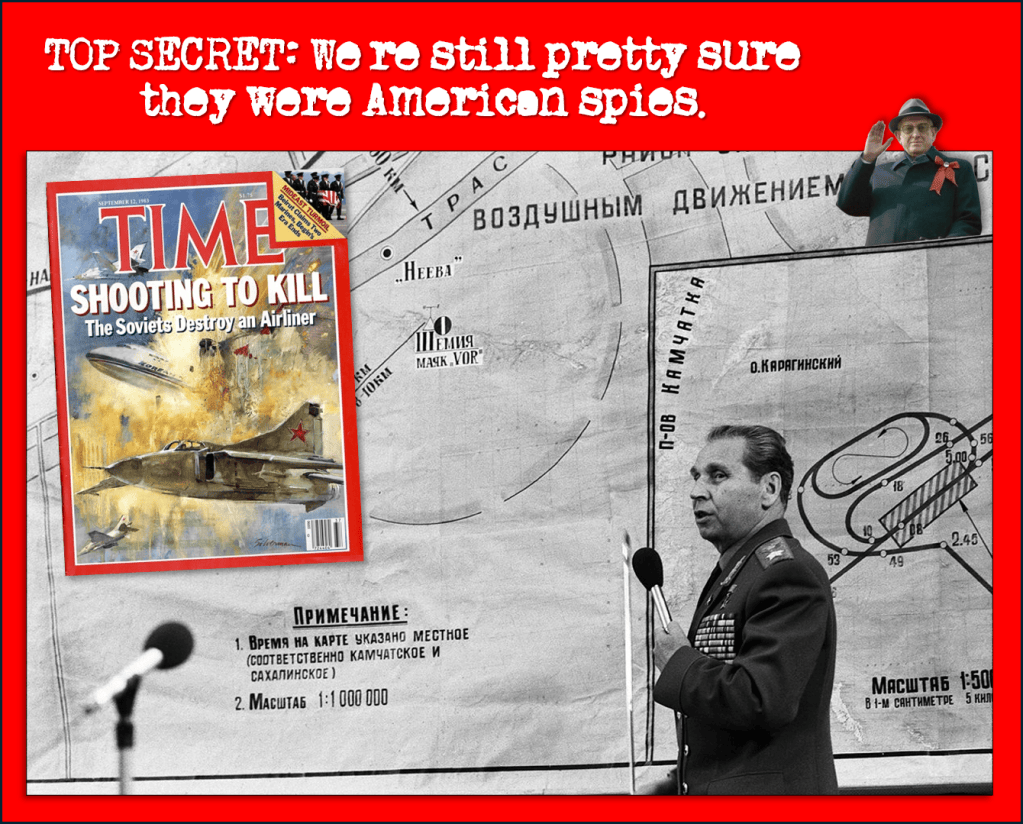
Last week we were fortunate enough to be given access to two Top Secret documents (without the “declassified” stamp, but that’s neither here nor there) regarding the 1 September 1983 Soviet shootdown of a civilian Korean airliner that, according to official accounts, inadvertently drifted into Soviet airspace during its New York City – Anchorage – Seoul route. When the aircraft was spotted crossing into Soviet airspace, efforts were made by ground controllers and (eventually) airborne Soviet pilots to contact the crew of the airliner to adjust its heading and depart back into international airspace. It did not acknowledge the warnings. Pilots of the pursuing fighter interceptors were asked to clearly identify the intruder, which was difficult due to the fact that this occurred in hours of darkness, the distance to the target was quite a ways off, and the aircraft (per the Soviets) was flying without navigation lights.
There was a presumption among the Reds was that this was a US military spy aircraft, carrying out its intelligence collection efforts over sensitive sites. Because of this presumption, it can be argued that the pursuing pilots were subconsciously predisposed to identify the aircraft as such, rather than a civilian airliner. Regardless, after hemming and hawing across the Soviet chain of command, the order was given to splash the intruder. Acting on this orders, Soviet Air Force pilot Major Gennadiy Osipovich, aboard his Su-15, launched two AA-3 air-to-air missiles at the Korean airliner. One missile exploded near the tail and severely damaged the airliner’s hydraulic and control lines, while the second struck the fuselage, causing rapid decompression. Everyone on board perished.
The first of the two documents is a straightforward excerpt from the Top Secret minutes of an 8 September Politburo meeting. Among the topics discussed was the need for the USSR to present its case to the world through a press conference, and to report to Chairman Chernenko on continuing work to salvage any pieces of the downed airliner that could be found, not least of which the so-called black boxes.
The second of the documents is a 37-page white paper on the KAL 007 incident and the subsequent global uproar against the Soviets. The report, drafted and signed by V.A. Martynov (Senior Advisor for the Historical Diplomatic Directorate of the Ministry of Foreign Affairs) is dated 7 January 1992. In addition to the Top Secret classification on the first page, each page is stamped “NOT FOR PUBLICATION”. In historical contexts (such as Soviet and Russian state archives), this stamp indicates that while certain researchers might be granted access to read the file internally, it remains legally barred from being published externally or reproduced in academic papers.
The document is a “briefing paper” that provides a Soviet-eye view of the aftermath of the downing of the South Korean Boeing 747, frequently referred to by its flight number, KAL-007. The paper provides the back-and-forth name calling and blame-and-shame efforts between the international community and the USSR. In its barest bones, the argument from (primarily) the United States was that the Soviets shot down the civilian airliner in cold blood, fully aware that it was a civilian airliner. The Soviets maintained that the loss of life was unfortunate, but the guilt should be laid at the feet of the US, clearly having used the civilian aircraft to penetrate Soviet airspace to carry out intelligence collection operations.
There is no cover letter or other amplifying data that would explain the reason or intended audience for this classified report, written nine years after the event. In fact, in 1992, Russian President Boris Yeltsin officially turned over the aircraft’s recovered flight data recorders (“black boxes”) and secret Soviet transcripts to the International Civil Aviation Organization (ICAO). The materials handed over by Russia confirmed that the civilian airliner had strayed off course entirely due to a pilot navigation error and was not conducting an intelligence collection operation.
Nothing explosive comes out of this paper; it can be somewhat confusing in trying to determine the reason for its high classification marking. That can be explained by the presence of Foreign Ministry conversations within its own walls, as well as with well-known foreign statesmen of the era. In addition, there are a number of documents cited that are essentially instructions from the Politburo to embassies and consulates around the world on how to deal with the diplomatic static.
The two documents have passed all of our tried-and-true authenticity checks. We have never before seen these documents available to the public in English or in Russian. That doesn’t mean they aren’t out there somewhere, but if they are, they are exceptionally camouflaged from our trained eyes.
Enjoy.
Document 1:
Top Secret
Only copy
(Working papers)
Meeting of the Politburo of the CPSU Central Committee
8 September 1983
Comrade K.U. CHERNENKO presiding.
In attendance: M.S. Gorbachev, V.V. Grishin, N.A. Tikhonov, G.V. Romanov, D.F. Ustinov, V.I. Vorotnikov, V.I. Dolgikh, V.V. Kuznetsov, M.S. Solomentsev, I.V. Kapitonov, K.V. Rusakov
…
13. On holding a press conference regarding the incursion of the South Korean aircraft
CHERNENKO: We have already decided to hold a press conference for Soviet and foreign journalists regarding the incident involving the South Korean plane. Perhaps the comrades working on this matter could brief us on the current situation.
G.M. KORNIYENKO (First Deputy Minister of Foreign Affairs): I can report to the Politburo that the working group, comprising representatives from the Foreign Ministry, the Ministry of Defense, and the KGB, is meeting on a daily basis, and relevant proposals are being drafted and submitted to the Politburo for consideration. Our main priority right now is preparing for the press conference scheduled for tomorrow at 3:00 p.m.
USTINOV: I will address our assessment of the incident involving the South Korean aircraft during my speech at the ceremony where Sevastopol receives its award.
CHERNENKO: That will be good.
CHEBRIKOV: I wish to report to the Politburo that thirteen American and Japanese ships and twenty-four of our own vessels are currently located in the area where the South Korean plane went down. They are concentrated in three locations. In addition, four American aircraft and five of our own are operating there. An American deep-sea operations vessel is currently en route to the site.
It should be noted that, as a provocation, the Americans announced over the radio in Russian that if Soviet aircraft appeared over active American ships, they would be shot down. This was, of course, a deliberate provocation.
Since the wind is blowing toward the Soviet coast, the sea has washed up approximately 900 various items related to the loss of the aircraft. No bodies have been found so far.
Certain new trends have emerged in American propaganda regarding the incident. First, there is constant speculation claiming that the plane was shot down not over Soviet territory, but over neutral waters. This is a deliberate lie. Second, an outcry has been raised over demands for compensation for the families of those on board. Third, questions are increasingly appearing in the US and Japanese press, in one form or another, as to why American authorities are remaining silent about the fact that the South Korean plane was being tracked. Many correspondents state outright that the time of night, the weather conditions, and the distance separating the plane from Soviet fighter jets made it impossible to accurately determine its identity. At the same time, many are expressing surprise that neither the Americans nor the Japanese have released any information regarding the activities of their own air traffic control services.
TIKHONOV: Will we be conducting deep-water operations in the area where the plane went down?
USTINOV: The Ministry of the Fishing Industry has a ship adapted for deep-sea operations. We will try to use it.
CHEBRIKOV: The depth there turned out to be 400–600 meters, rather than the 80–100 meters previously estimated. Working at such a depth will be quite difficult. Moreover, the waters are in the neutral zone.
GORBACHEV: Has the question of how we should act at the ICAO [International Civil Aviation Organization] meeting not been worked out?
CHEBRIKOV: The ICAO has no authority to discuss the issue of the aircraft incident.
TIKHONOV: However, the Pilots Association stated that it would not deal with us for two months.
[Translator note: This probably refers to the Air Line Pilots Association, International]
CHERBIKOV: It found itself in a rather difficult position. There are many foreign tourists in the Soviet Union right now. Who will fly them out if Aeroflot planes are not accepted? So far, only the US and Canada have imposed sanctions against Aeroflot.
As for our country, our people’s attitude toward the incident is the most level-headed and sensible one. It is worth noting that American and other foreign correspondents tried walking around Moscow with tape recorders, asking passersby for their views on the incident involving the South Korean plane. The responses were so firm and sharp that the correspondents very quickly beat a hasty retreat.
CHERNENKO: Now the main thing is to successfully hold the press conference. You have the resolution on this matter. Are there any objections to approving it?
POLITBURO MEMBERS: None. It can be approved.
The resolution is adopted.
Document 2:
Top Secret. Copy No. 1
Regarding the Incident with the South Korean Passenger Aircraft (1983)
(Briefing Paper)
On the morning of September 1, 1983, media outlets in several countries reported the disappearance of a South Korean Airlines (KAL) Boeing 747 passenger aircraft in the Far East, Flight 007, en route from New York to Seoul via Anchorage, carrying 269 people on board.
That same day, at approximately 12:30 a.m. (local time), U.S. Deputy Secretary of State R[ichard] Burt telephoned the Soviet embassy in Washington. He stated that, according to the information U.S. tracking stations had managed to gather up to that point, an aircraft might have “accidentally violated USSR airspace in that area” and made a forced landing there. U.S. agencies possessed no further information about the plane at that time. South Korean authorities had asked the United States to inquire with Soviet officials about what was known regarding the aircraft’s fate.
In this regard, Bert raised two questions, asking that they be conveyed to Moscow:
– Do we have any information at all about this aircraft and its landing?
– If so, is it possible that the aircraft, having accidentally entered USSR airspace, was forced to land in the vicinity of Sakhalin Island on Soviet territory?
[AVP RF, F.059, op. 78, p.88, d. 275, l. 185-188]
That same morning, U.S. Under Secretary of State L. Eagleburger invited M. Sokolov, the USSR Chargé d’Affaires, to the State Department and made an oral statement outlining the American version of the details regarding the South Korean airliner’s flight. The gist of the statement was that “the South Korean civilian aircraft was deliberately attacked by a Soviet aircraft, resulting in the destruction of the South Korean airliner.”
“In light of the information indicating that the South Korean aircraft was destroyed by a Soviet aircraft,” Eagleburger said, “it is crucial that we receive an immediate explanation from the Soviet side regarding the circumstances of this incident.”
It is evident that such a serious incident could have had far-reaching international consequences.
[AVP RF, F.059, op. 78, p.88, d. 275, l. 189-190]
Half an hour after the meeting between Eagleburger and Sokolov, U.S. Secretary of State George Shultz publicly reiterated the American version at a press briefing.
[AVP RF, F.059, op. 78, p.88, d. 275, l. 192-193]
On the morning of September 1 in Tokyo, Soviet Ambassador V. Ya. Pavlov was summoned to the Japanese Foreign Ministry to meet with E. Kato, Director-General of the European and Oceania Affairs Bureau; Kato conveyed the Japanese side’s urgent request to “investigate the facts and immediately inform” the Japanese government regarding the disappearance of the South Korean aircraft.
[AVP RF, F.059, op. 78, p.88, d. 901, l. 115-116]
On September 1, the Soviet embassies in Washington and Tokyo were instructed to urgently inform the U.S. State Department and the Japanese Foreign Ministry, respectively, of the following:
“On the night of August 31–September 1 of this year, an aircraft of unidentified affiliation entered the airspace of the Soviet Union from the direction of the Pacific Ocean over the Kamchatka Peninsula, and subsequently violated USSR airspace a second time over Sakhalin Island. The aircraft was flying without navigation lights; it did not respond to inquiries and did not establish contact with air traffic control services.
“Air defense fighter jets that were scrambled to intercept the intruder attempted to assist in guiding it to the nearest airfield. However, the aircraft did not react to the signals and warnings issued by the Soviet fighters, and continued its flight toward the Sea of Japan.
“Following an appeal from the American (Japanese) side, we have taken measures to search for this aircraft. As a result, signs of a possible crash were discovered in the vicinity of Moneron Island. Search operations in the area are ongoing.”
[AVP RF, F.029. op. 27, p. 14, d.114, l.154-155]
On September 2, a TASS report identical in content—with the exception of the final paragraph—was published.
The Soviet Embassy in Tokyo reported that on September 2, 1983, the Japanese government “reached the definitive conclusion that the South Korean aircraft had been shot down by a missile attack from a Soviet fighter.” During a cabinet meeting, the decision was made to establish an emergency council headed by the Prime Minister, alongside the incident investigation task force previously set up within the Ministry of Foreign Affairs, comprising the Chief Cabinet Secretary, the Ministers of Foreign Affairs and Transport, and the Director-General of the Defense Agency.
[AVP RF, F.059, op. 78, p.283, d.901, l. 128-129]
On September 3, 1983, Japanese Foreign Minister S. Abe made the following statement to V. Ya. Pavlov at the Japanese Foreign Ministry:
“After analyzing various data, including radar information, the Japanese side have concluded that the South Korean airline KAL passenger aircraft, flying the New York–Anchorage–Seoul route, was attacked by a Soviet fighter jet on the morning of September 1 and was shot down at 3:38 a.m. southwest of Sakhalin, near Moneron Island. The Japanese government holds that such actions, regardless of the reasons behind them, are absolutely unacceptable when directed at civilian aircraft, and are to be resolutely condemned. Given that this incident resulted in the deaths of 269 people, including 28 Japanese citizens, the Japanese side urgently demands that the Soviet side provide immediate and sincere explanations, as well as reliable information regarding the incident…”
[AVP RF, F.0146, op. 84, p.455, d.4, l. 23]
Throughout September, representations were repeatedly made to the Soviet embassy in Tokyo regarding various issues related to the incident.
[AVP RF, F.059, op. 78, p.283, d.901, l. 152-155, 187-189, 244-247]
On September 2, the White House press secretary issued a statement on behalf of President Reagan from California. It stated that the United States felt “revulsion” at this “horrible act of violence” and “joins other members of the international community in demanding a full explanation of this outrageous and senseless act.” “Deepest condolences” were expressed to the families of the victims, a pledge was made to “make every effort to get to the truth” of this tragedy, and orders were issued to fly United States flags at half-staff at all government facilities and American military bases worldwide. (U.S. Congressman L. McDonald was among the victims of the incident.)
[AVP RF, F.059, op. 78, p.88, d.275, l. 203-204]
That same day, before departing California for Washington, Reagan personally issued a statement. In addition to condemning the “barbaric act committed yesterday by the Soviet regime against a commercial airliner,” the statement noted, in broader terms, the Soviet Union’s “readiness to advance its interests through violence and intimidation” and the “glaring contrast between the Soviet Union’s words and deeds.” It also highlighted the impossibility of trusting a state that “so loudly proclaims its commitment to peace and global disarmament while simultaneously committing, with such brutality and speed, a terrorist act that sacrifices the lives of innocent people…”
[AVP RF, F.059, op. 78, p.88, d.275, l. 226-227]
A TASS statement dated September 2, 1983, and published on September 3, 1983, asserted that “during the night of August 31–September 1 of this year, an aircraft of unidentified affiliation flagrantly violated the Soviet state border and deeply penetrated the airspace of the Soviet Union. The intruding aircraft deviated from the established international flight path toward Soviet territory by up to 500 kilometers and spent more than two hours over the Kamchatka Peninsula, the Sea of Okhotsk region, and Sakhalin Island.
“In violation of international regulations, the aircraft was flying without navigation lights; it did not respond to radio signals from Soviet air traffic control services, nor did it make any attempt to establish such contact itself.
“While the unidentified intruder aircraft was in USSR airspace,” the statement continued, “Soviet aircraft…repeatedly attempted to establish contact using standard signals and to guide it to the nearest airfield within Soviet territory. However, the intruder aircraft ignored all of this. Over Sakhalin Island, a Soviet aircraft fired warning shots using tracer rounds along the intruder’s flight path.
“Shortly thereafter, the aircraft exited Soviet airspace and continued flying toward the Sea of Japan. It remained within radar surveillance range for approximately ten minutes, after which tracking was lost.”
Citing the “uproar raised in the USA and certain other countries regarding the disappearance of the South Korean plane flying from New York to Seoul,” the statement noted that “information coming from the United States provides increasing grounds to believe that the flight’s route and nature were not accidental.” It also drew attention to the fact that “the very first report on the matter (in the USA — V.M.) cited the US Central Intelligence Agency.” The American authorities’ reaction to the incident was characterized as “filthy insinuations against the USSR,” while the “intrusion of the said aircraft into [Soviet] airspace” was viewed as a “premeditated action,” the pursuit of special intelligence objectives “under the cover of civilian aircraft.”
The conclusion was drawn that “those who organized this provocation deliberately sought to further aggravate the international situation, aiming to discredit the Soviet Union, incite hostility toward it, and cast a shadow over the Soviet Union’s peace-loving policies.”
President Reagan’s remarks regarding the Soviet Union in connection with the incident were described as “brazen” and “slanderous.”
TASS was authorized to state that “leadership circles in the Soviet Union express regret over the loss of life while simultaneously strongly condemning those who, whether deliberately or through criminal negligence, allowed the loss of human life to occur, and who are now attempting to exploit the incident for unscrupulous political ends.”
The Soviet Embassy in Washington was instructed to convey the text of the statement to U.S. Secretary of State George Shultz or his deputy verbatim, with the exception of the assessment of Reagan’s speech, and with the addition of the following concluding paragraph:
“It should be clear to the U.S. Government that a continued policy of further escalating tensions in Soviet-American relations and in the world at large would serve neither the interests of our two countries nor the resolution of major problems that genuinely exist.”
[AVP RF, F.029, op. 27, p. 14, d. 114, l. 161-163]
The leaders of East Germany, Hungary, Romania, Poland, Czechoslovakia, Bulgaria, Cuba, Mongolia, and Vietnam were informed of the content of the submission to the US government.
The governments of Japan and Canada were also informed, in addition to this information, that “the Soviet side is conducting a search in the area where the aircraft is believed to have crashed, and the Japanese (Canadian) side will be apprised of the results.”
[AVP RF, F.029, op. 27, p. 14, d. 114, l. 163]
Given that the governments of certain countries had signaled their expectation of more formal statements from the Soviet side, including expressions of regret regarding the incident, instructions were issued on October 5, 1983, to all Soviet ambassadors, representatives, and consuls general. They were directed to “explain that the aforementioned TASS statement sets forth the official position of the Soviet government.” At the same time, attention was to be drawn to the fact that the statement “explicitly expresses the Soviet leadership’s regret over the loss of human life” while also containing a “firm condemnation of those who, whether deliberately or through criminal negligence, allowed the loss of life to occur and are now attempting to exploit the incident for unscrupulous political ends.
[AVP RF, F.029, op. 27, p. 14, d. 114, l. 137]
On September 5 at 8 p.m., President Reagan addressed the nation on American television from the White House regarding the incident involving the South Korean airliner and U.S. “retaliatory measures” against the USSR.
Among other things, Reagan asserted that the USSR had committed a “crime against humanity” and flagrantly violated “all canons of human rights,” and that “there is neither legal nor moral justification for its actions.”
The US President “presented the American version of the incident involving the South Korean aircraft” and “attempted to justify the spy missions carried out by American reconnaissance aircraft near the Soviet Union.”
[AVP RF, F.059, op. 78, p. 89, d. 276, l. 50]
A “fact sheet” released concurrently with the President’s address outlined a list of “countermeasures,” offering certain clarifications and elaborations beyond the text of Reagan’s speech.
Regarding diplomatic efforts, the document stated that the U.S., in cooperation with other nations, would continue to insist that the Soviet side provide a “full account of what happened, offer an apology, acknowledge responsibility, and appropriately punish those at fault.” The State Department was continuing to consult with its advisors and allies; the U.S., together with Japan, would press the Soviet Union for permission to “gain immediate access to the wreckage or the bodies of the victims”; and during the UN Security Council meeting on September 6, Ambassador Kirkpatrick would make public the full transcript of the Soviet pilots’ conversations regarding the downing of the Korean airliner.
In the realm of bilateral relations, the measures included the “suspension of negotiations on a number of bilateral agreements” and a “decision not to renew the bilateral agreement on cooperation in the field of transport.”
Regarding air transport safety, the U.S. side requested the International Civil Aviation Organization (ICAO) to investigate the Soviet Union’s actions during a special session of the ICAO Council; with the aim of “isolating Aeroflot internationally,” the U.S. administration intended to “support international non-governmental organizations in restricting Aeroflot’s ground support operations” and to oppose negotiations unrelated to safety issues between Aeroflot and other national civil aviation organizations.
And finally, the United States intended, through diplomatic channels, to [unclear text] deceased American citizens, as well as those whose private interests are affected.
[AVP RF, F.059, op. 78, p. 89, d. 276, l. 55-57]
On September 7, 1983, a Statement by the Soviet government was broadcast via radio and Central Television and published in the press; it stated, among other things, that an investigation conducted following the “TASS statement issued on the authority of the Soviet government” on September 2, 1983, “confirmed previously cited data and amplified them… Having thoroughly analyzed the actions of the intruding aircraft and its flight path, which took it over military bases in the Sakhalin area, the regional air defense command conclusively determined that a reconnaissance aircraft carrying out special missions was present in USSR airspace. We are further led to this conclusion by the fact that the aircraft was flying a course that took it through strategically important regions of the Soviet Union.” After the “intruding aircraft failed to comply with the demand to proceed to a Soviet airfield and attempted to escape, a fighter-interceptor… carried out the command post order to halt the flight…”
“Soviet pilots, while intercepting the intruding aircraft, could not have known that it was a civilian plane. It was flying without navigation lights, in the dead of night and in conditions of poor visibility, and failed to respond to signals. The US President’s assertions that the Soviet pilots knew it was a civilian aircraft are completely at odds with the facts.”
The statement concluded that this was a “deliberate, premeditated action in an area of strategic importance to the Soviet Union. Its organizers could not have failed to understand the potential consequences, yet they proceeded with a major intelligence-gathering operation using, as has now come to light, a civilian aircraft, thereby knowingly placing its passengers in mortal danger… The plan was to carry out the aforementioned intelligence operation without hindrance but, should it be intercepted, to turn the entire incident into a large-scale political provocation directed against the Soviet Union.”
This conclusion is confirmed by all the subsequent actions of the US administration. Its leaders, including the US President himself, launched a vicious, hostile anti-Soviet campaign within an extremely short timeframe, clearly following a pre-arranged script. The essence of this campaign was most starkly revealed in the address delivered by US President Ronald Reagan on American television on September 5: an attempt to discredit the Soviet Union and its social system, to incite hatred toward the Soviet people, to distort the aims of Soviet foreign policy, and to divert attention from the USSR’s peace initiatives… By all indications, including the aforementioned speech by the American President, the US administration intends to pursue a course of further escalating confrontation with the Soviet Union.”
In conclusion, the statement read: “The Soviet government expresses its regret over the loss of innocent lives and shares the grief of their families and loved ones. The leadership of the United States of America bears full and complete responsibility for the tragedy that has occurred.”
All Soviet ambassadors, representatives, and consuls general were instructed to “officially convey the text to the government of the host country, taking local conditions into account, and to disseminate it via the mass media wherever possible,” as well as to conduct “active work within political and public circles, as well as among the diplomatic corps and members of the press,” on the basis of this Statement.
[AVP RF, F.029, op. 27, p. 14, d. 114, l. 153]
The Soviet Embassy in Washington was instructed to accompany the text of the Statement with an oral statement, which stated, in particular, that “The facts presented in the Statement of the Soviet Government published on September 6 clearly indicate that the incursion of a South Korean aircraft into Soviet airspace in the Far East on the night of August 31 to September 1 was organized by American intelligence services. This is confirmed by other information we have, but we do not intend to make it public because of its classified nature.”
There is no doubt that this was a major reconnaissance operation undertaken in a strategically important area of the Soviet Union, utilizing a specially equipped aircraft with passengers on board for this purpose…
The US leadership, regardless of whether or not it was aware of each such operation in advance, bears full responsibility for such barbaric practices and their consequences.
As for this specific incident, the subsequent course of events leaves no room for doubt that US intelligence agencies acted with the knowledge and approval of the highest authorities.
A number of specific questions were then raised regarding the flight path and the actions of the crew as well as American and Japanese aviation services; the conclusion was drawn: “Instead of seeking answers to all these and many other questions and identifying those responsible for such ‘anomalies’ that led to tragic consequences, US leaders, including the President himself, immediately resorted to utterly brazen insinuations against the Soviet Union, unworthy of statesmen, in an attempt to blacken its name in the eyes of the world public.
“Resolutely and indignantly rejecting attempts by the US government to absolve itself of responsibility for the deaths of the people aboard the South Korean aircraft and to shift that responsibility onto the Soviet Union, the Soviet side warns the American side of the dangerous consequences of the United States continuing its current irresponsible course in relations with the USSR and in international affairs as a whole.”
[AVP RF, F.029, op. 27, p. 14, d. 114, l. 187-189]
(O.M. Sokolov handed the text of the statement to Acting Secretary of State J. Kelly on the evening of September 6, and the additional instruction on September 8, 1983.)
[AVP RF, F.059, op. 78, p. 89, d. 276, l. 95]
On September 7, Soviet Foreign Minister A.A. Gromyko, speaking in Madrid at a meeting of representatives of the states participating in the Conference on Security and Cooperation, stated: “It is well known that this incident is being deliberately exploited by certain circles in the USA to aggravate the international situation. They have whipped up a wave of slander and unscrupulous insinuations against the USSR and the socialist countries.
“We resolutely and indignantly reject all of this. The fundamental question that arises is: does anyone have the right to violate the borders of others or the sovereignty of another state with impunity? No, no one has such a right. This important principle is enshrined in the most authoritative documents, including the UN Charter.
“As has been fully established, the South Korean aircraft was of special interest to US authorities and their intelligence agencies. It intruded into Soviet airspace…and remained there for a prolonged period, flying over our strategic military installations.
“Why and how did it end up there? There are persistent attempts to evade answering this legitimate question… We declare: Soviet territory and the borders of the Soviet Union are sacrosanct. Whoever resorts to such provocations must know that they will bear full responsibility for them.
“This criminal act cannot be justified by either the unscrupulous manipulation of facts or false narratives cloaked in the guise of concern for human rights, regardless of the level at which they are advanced.” The entire incident was characterized as a “major provocation exploited by its organizers to further their militaristic policies and stoke war hysteria.”
On September 9, the Soviet Ministries of Defense and Foreign Affairs held a press conference for Soviet and foreign journalists. Participants included N.V. Ogarkov, Chief of the General Staff of the Armed Forces; G.M. Korniyenko, First Deputy Minister of Foreign Affairs; and L.M. Zamyatin, Head of the International Information Department of the CPSU Central Committee.
In his opening remarks, N.V. Ogarkov stated that, “fully grasping the gravity of the incident, the Soviet government established a special, highly competent state commission that very same day.” The commission included senior specialists and experts from various agencies, including the State Aviation Oversight Authority.
It has been irrefutably proven that the South Korean airliner’s intrusion into Soviet airspace was a deliberate, meticulously planned reconnaissance operation. It was directed from specific centers located in the United States and Japan. A civilian aircraft was deliberately chosen, with no regard for, and perhaps even with the expectation of, human casualties.
The organizers of the press conference presented factual data regarding specific stages of the flight and answered questions posed by the attendees.
Subsequently, the Soviet press repeatedly published materials, both propagandistic and specialized-professional in nature, regarding various aspects of the Boeing 747 incident.
Sanctions against Aeroflot
Following the incident involving the South Korean aircraft, the governments of a number of countries (the UK, Belgium, Denmark, Italy, Canada, Luxembourg, the Netherlands, Norway, West Germany, Switzerland, and Japan) announced the suspension of air links with the USSR for periods ranging from two weeks to two months.
Among countries that did not have air service agreements with the Soviet Union, Iceland banned Aeroflot aircraft from landing at its airports or flying over its territory for two weeks; Australia and New Zealand imposed a ban of up to 60 days on commercial dealings involving their airlines and adopted a number of discriminatory measures against Soviet citizens.
The measures taken by the Japanese government, for example, were as follows:
On September 9, 1983, the Soviet embassy reported an announcement made that same day stating that Japan would refrain “for some time…from issuing permits for non-scheduled (charter) flights by Aeroflot aircraft” and would refuse “to consider requests from the Soviet side to increase the number of scheduled flights or change the type of aircraft used.” Furthermore, government and local authority employees were prohibited — and all other Japanese nationals were advised — to refrain from using Aeroflot services.
Speaking at the cabinet meeting where this decision was adopted, Prime Minister Y. Nakasone said that he “would like to avoid the impact of this incident on key areas of Japanese-Russian relations.”
[AVP RF, F.059, op. 78, p.283, d. 901, l. 218-219]
(On September 13, E. Kato informed the Soviet ambassador of “additional measures” regarding the Soviet Union:
1. From 00:00 on September 15 until 24:00 on September 28 of this year, flights by all Soviet aircraft within Japanese airspace and landings on Japanese territory are prohibited.
2. During the specified period, flights by Japanese aircraft within USSR airspace and landings on USSR territory are not permitted.)
[AVP RF, F.059, op. 78, p.283, d. 902, l. 6-7]
On September 3, 1983, Acting U.S. Secretary of State Eagleburger summoned Soviet Ambassador A.F. Dobrynin to the State Department and, in addition to previously announced “retaliatory measures,” officially stated the U.S. authorities’ decision to “no longer permit the Soviet airline Aeroflot to maintain offices in the United States.” The State Department requested the USSR Embassy to ensure that Aeroflot’s offices in New York and Washington cease all operations no later than September 15, 1983, and that all Soviet citizens admitted to the United States to work as Aeroflot officials or employees, as well as their dependents and other accompanying persons, depart the United States no later than September 15, 1983.
Additionally, citing Article 12 of the Air Transport Agreement between the Government of the United States and the Government of the USSR of November 4, 1966, the United States holds the view that the Soviet Union does not currently have the right, under the aforementioned article, to maintain Aeroflot representative offices in the United States.
[AVP RF, F.059, op. 78, p.89, d. 276, l. 102-104]
Later that same day, September 8, the White House announced that President Reagan had directed the U.S. civil aviation authorities to impose the following additional bans, effective September 12:
– to suspend Aeroflot’s right to sell tickets for travel to the United States;
– to prohibit U.S. airlines from selling tickets for Aeroflot flights to the United States;
– to prohibit U.S. airlines from transporting passengers on tickets that include Aeroflot flights;
– to order U.S. airlines to suspend any international contracts with Aeroflot;
– to prohibit U.S. airlines from accepting any tickets issued by Aeroflot for travel to, from, or within the United States.
The same White House statement announced the U.S. authorities’ decision to require the closure of Aeroflot’s offices in the United States and the departure of their personnel from the country by September 15.
[AVP RF, F.059, op. 78, p.89, d. 276, l. 104-105]
In response to the aforementioned sanctions imposed on Aeroflot, the Central Committee of the CPSU adopted a resolution directing that formal representations be made to all the countries involved. These representations conveyed a “principled assessment” of their stance, lodged a formal protest, and placed “full responsibility for the consequences of their unlawful actions” upon them. The countries that had violated the agreement were also informed that “we reserve the right to lodge financial claims against them.” These representations were delivered orally to representatives of the respective countries in Moscow, with the approach tailored to each case, “taking into account the specific position adopted by the country in question and the nature of relations with it.”
[AVP RF, F.029, op. 27, d.14, d. 114, l. 183, 186-190]
The Japanese embassy was informed, for instance, that “air transport links constitute a significant component of the overall relationship between the USSR and Japan” and that “statements by Japanese officials regarding the undesirability of any negative impact of the aforementioned measures on relations between the two countries seem, to say the least, strange.”
[AVP RF, F.029, op. 27, d.14, d. 114, l. 187; F.059, op. 78, p. 281, d. 891, l. 44-45]
Consideration of the matter in the UN Security Council and the General Assembly
At its 2470th meeting on 2 September 1983, the Security Council included in its agenda, without objection, the consideration of letters addressed to the President of the Security Council from the Acting Permanent Representative of the United States of America to the United Nations (S/15947), the Permanent Observer of the Republic of Korea to the United Nations (S/15948), the Chargé d’affaires of the Permanent Mission of Canada to the United Nations (S/15949), the Permanent Representative of Japan to the United Nations (S/15950), and the Acting Permanent Representative of Australia to the United Nations (S/15951), dated 1 September 1983, in which the actions of the Soviet Union regarding the South Korean aircraft incident were characterized as a violation of the norms and practices of international civil aviation and of international law.
On September 2, 1983, the Soviet representative to the UN was instructed as follows regarding the US proposal to place the issue of the South Korean plane’s destruction on the UN Security Council agenda:
1. To categorically object to the convening of the Council to discuss this matter, arguing that it does not fall within the category of issues affecting international peace and security.
2. In the event that “it proves impossible to prevent the said issue from being raised in the Council,” to “set forth our principled position, guided by the TASS Statement of September 2 of this year and the instructions given to the Soviet ambassador in Washington.”
In addition, instructions were issued to steer the proceedings toward “the swiftest possible winding down of the discussion on this matter,” to prevent at all costs “the adoption by the Council of any resolution that might cast a shadow on us,” and, if necessary, to exercise the veto.
[AVP RF, F.029, op. 27, p.14, d. 114, l. 164]
On September 3, the representative to the UN was instructed that, in the event the American side attempted, during the Security Council meeting, to present “factual materials,” specifically recordings of allegedly intercepted conversations between Soviet interceptor pilots, he should state, “without getting drawn into a debate over the authenticity or lack thereof of any radio intercepts,” that the presentation of such fabricated materials was a deliberate attempt to steer the discussion down a false path and to evade the central question: how and for what purpose the South Korean aircraft had strayed so far from the international flight path it was supposed to follow. The facts of the matter as they truly stand, rather than as some are currently attempting to distort them, point unequivocally to who bears full responsibility for the incident involving the South Korean aircraft.
[AVP RF, F.029, op. 27, p.14, d. 114, l. 140-142]
At the 2474th meeting on 8 September, the representative of the Netherlands introduced a draft resolution (S/15966) sponsored by Australia, Canada, Malaysia, the Netherlands, New Zealand, the United Kingdom of Great Britain and Northern Ireland, the United States of America, France, and Japan, under which the Security Council:
1. expressed “deep regret over the destruction of the Korean airliner and the tragic loss of civilian lives that ensued”;
2. declared that “such use of armed force against international civil aviation is incompatible with the norms governing international conduct and with elementary considerations of humanity”;
3. urged “all States to observe the purposes and principles of the Chicago Convention on International Civil Aviation”;
4. welcomed “the decision to convene an urgent meeting of the Council of the International Civil Aviation Organization to consider the incident involving the Korean airliner”;
5. strongly urged “all states to cooperate fully with the International Civil Aviation Organization in efforts to strengthen the safety of international civil aviation and to prevent any recurrence of such use of armed force against international civil aviation;”
6. requested the Secretary-General “… to conduct a full investigation into the circumstances of this tragedy” and
7. “… to report his findings to the Security Council within fourteen days.”
At the 2476th meeting, on 12 September 1983, the draft resolution (5/15966/Rev.1) was voted by 9 members (Jordan, Malta, the Netherlands, Pakistan, the United Kingdom of Great Britain and Northern Ireland, the United States of America, Togo and Georgia), 2 against (Poland and the Union of Soviet Socialist Republics), with 4 abstentions (Guyana, Zimbabwe, China and Nicaragua), and was not adopted because one permanent member of the Council voted against it.
Amid the anti-Soviet campaign in the U.S. surrounding the South Korean aircraft incident, the Soviet leadership decided not to send Foreign Minister A.A. Gromyko to head the USSR delegation at the 38th session of the UN General Assembly; the American side was informed of this on September 18, 1983, during a conversation between Soviet Ambassador to the U.S. A.F. Dobrynin and Assistant Secretary of State R. Burt. According to the ambassador, Burt was “stunned” by the decision and described it as an “excessive reaction.”
[AVP RF, F.059, op. 78, p.89, d. 277, l. 151-152]
(Two days earlier, on September 16, 1983, R. Burt informed O. M. Sokolov that the U.S. government would be willing to authorize a flight by a special Soviet aircraft to New York on September 18, provided that it was a Soviet military aircraft rather than an Aeroflot plane. Arrangements for its reception and servicing were guaranteed at a military airfield near New York City.)
[AVP RF, F.059, op. 78, p.89, d. 277, l. 106-107]
That same day, Burt called the embassy back and conveyed an “official message” from the U.S. government to O. M. Sokolov, stating that it did not believe “the reasons behind the decision regarding the impossibility of A. A. Gromyko coming to New York for the UN General Assembly session had been explained to him in a satisfactory manner,” and further stating that it did not consider itself to be “impeding his arrival” and was prepared to take appropriate measures to ensure both Mr. A. A. Gromyko’s safety and the arrival of his aircraft.
[AVP RF, F.059, op. 78, p.89, d. 277, l. 161-162]
At the session itself, on the opening day of the General Assembly (September 26, 1983) President Reagan stated that “the reaction to the Korean airliner tragedy served as a timely reminder of just how different the Soviet conception of true international cooperation is from that of the rest of the world.” On September 28, Japanese Foreign Minister S. Abe described the incident as “an intolerable challenge to humanity and international law. The Soviet Union not only failed to provide Japan and other interested countries with any satisfactory explanation of the facts, but also attempted to shift the blame onto others.” Abe called upon the Soviet Union to respond immediately to the international community’s condemnation of this unlawful act and to duly acknowledge its responsibility.
Representatives of many states, particularly developing ones, were considerably more restrained in their assessments; like President Siaka Stevens of Sierra Leone, they expressed “deep regret” regarding the “political atmosphere and psychological climate” that had given rise to “this regrettable incident.”
During the 33rd session of the UN General Assembly, on September 23, a statement of fundamental importance regarding the international situation was issued by Yu.V. Andropov, General Secretary of the Central Committee of the CPSU and Chairman of the Presidium of the Supreme Soviet of the USSR.
The course pursued in international affairs by the United States administration was characterized as militaristic and “posing a serious threat to peace.” Its essence lay in attempting to secure a dominant global position for the USA, without regard for the interests of other states and peoples.
“Another example of extreme political adventurism is the sophisticated provocation orchestrated by United States intelligence agencies using a South Korean aircraft. We have covered the facts of this operation in detail and with accuracy. The guilt of its organizers, no matter how they twist and turn or what false narratives they concoct, has been proven.”
This “unprecedented criminal act of sabotage,” the Statement declared, “lies on the conscience of those who seek to arrogate to themselves the right to disregard state sovereignty and the inviolability of borders; those who conceived and carried out this provocation; and those who, the very next day, hastened to push massive military appropriations through Congress and are now rubbing their hands in glee… The ‘humanitarianism’ of those figures who strive to shift the blame for the deaths of the people on board the plane manifests itself in new stockpiles of weapons of mass destruction, ranging from MX missiles to containers of nerve gas.”
The address delivered at the 38th session of the UN General Assembly by O.A. Troyanovsky, Permanent Representative of the USSR to the UN and Deputy Head of the Soviet delegation (in the absence of A.A. Gromyko), was also consistent with the spirit of Yu.V. Andropov’s statement.
Following the conclusion of the 38th session of the UN General Assembly, the propaganda intensity surrounding the incident, particularly by the Americans, subsided significantly. During a meeting between A.A. Gromyko and G. Shultz in Stockholm on January 18, 1984, held to exchange views on a wide range of international and bilateral issues, the U.S. Secretary of State raised the matter only in the context of the need to establish an “international air corridor in the Far East, where the South Korean aircraft was recently lost.” He noted that the issue was currently being discussed within ICAO and emphasized the need to properly equip the route, specifically with radio beacons, and to reach an agreement on establishing communication links between air traffic control services. In short, the goal was to ensure the safety of flights along that route.
[AVP RF, F.029, op. 28, p.1, d. 3, l. 164-165]
To this, the Soviet minister replied: “Regarding ICAO. The issue you raised is currently being examined by the relevant institute. Both your representatives and ours are there. Let them try to work out a mutually acceptable position… This can be done, provided they are not driven solely by a desire to oppose the other side’s position, even when that position is justified.”
[AVP RF, F.029, op. 28, p.1, d. 3, l. 163]
Discussion of the Incident at ICAO
On September 16, 1983, at an extraordinary session of the ICAO Council in Montreal, a resolution was adopted, proposed by Australia, the UK, Ghana, Spain, Italy, Canada, the Netherlands, the USA, the FRG, France, and Japan, which acknowledged that “such use of armed force against international civil aviation is incompatible with the norms governing international conduct and elementary considerations of humanity, as well as with the rules, standards, and recommended practices set forth in the Chicago Convention and its Annexes, and entails generally recognized legal consequences”; reaffirmed the principle that “States, when intercepting civil aircraft, must not use weapons against them”; expressed concern that “the Soviet Union still does not acknowledge the paramount importance of ensuring the safety and preserving the lives of passengers and crew members when civil aircraft are intercepted within or near its airspace”; and emphasized that “these actions constitute a serious threat to the safety of international civil aviation.” The Secretary General was requested to initiate an investigation to ascertain the facts regarding the flight and the destruction of the aircraft, and to submit a preliminary report to the Council within 30 days and a full report during the Council’s 110th session.
[AVP RF, F.059, op. 78, p.205, d. 651, l. 95-96]
Representatives of the USSR and the Ukrainian SSR voted against this resolution; Algeria, the PRC, and India abstained; and representatives from Iraq and Lebanon did not participate in the Council’s proceedings.
[AVP RF, F.029, op. 28, p.1, d. 3, l. 93]
In light of the unfavorable outcome for the USSR regarding the discussion of the South Korean aircraft issue within the ICAO Council, the following additional directives were issued on September 19 to the Soviet delegation attending the 24th Session of the ICAO Assembly (held from September 20 to October 10, 1983):
“1. Firmly object to and vote against the adoption of any Assembly resolutions aimed at condemning the Soviet Union or holding it responsible for the termination of the flight of the South Korean aircraft that had intruded into USSR airspace…
“2. Categorically reject proposals to conduct any investigations under ICAO auspices, including into the technical aspects of the aircraft incident, stating that the Soviet side possesses sufficient capabilities to conduct the necessary investigation,” and adding that “upon completion of the investigation, the Soviet side will be prepared to inform ICAO of the results.
“3. Propose, either directly at the Assembly session or through the ICAO Council acting on its mandate, the development of clear rules that elaborate on and specify the general provisions of the Chicago Convention… regarding the inadmissibility of the misuse of civil aviation and its employment for any purpose incompatible with the objectives of that Convention.
“4. Propose the development, within the framework of ICAO, of rules specifying the obligations of states — specifically their air traffic control (ATC) authorities — as well as those of airlines and flight crews, regarding the prevention of airspace violations involving foreign states and the enforcement of flight regimes therein…
“9. Raise no objection to considering the issue of the non-use of weapons against intercepted civil aircraft, provided this is done without reference to the South Korean aircraft incident and is closely linked to the development of the measures we have proposed (points 3–7 of these directives) aimed at preventing the use of civil aircraft for unlawful purposes and averting violations of foreign airspace.
“Emphasize that, conversely (that is, if divorced from the measures we have proposed), adopting a proposal for a mandatory ban on the use of weapons against civil aircraft would tacitly authorize the use of civil aircraft for reconnaissance and other unlawful purposes, a scenario that must be absolutely ruled out.”
[AVP RF, F.029, op. 27, p.14, d.114, l. 130-132]
The decision of the ICAO Council of September 16, 1983, was endorsed by an ICAO Assembly resolution adopted at the plenary meeting of the 24th Session of the Assembly on October 1, 1983.
Sixty-five countries voted in favor of the resolution; the USSR, the People’s Republic of Bulgaria, the Hungarian People’s Republic, the Polish People’s Republic, the Czechoslovak Socialist Republic, the Socialist Republic of Vietnam, the Socialist Republic of Romania, Cuba, Afghanistan, and the People’s Democratic Republic of Yemen voted against it; and 26 delegations abstained.
[AVP RF, F.029, op. 27, p.14, d.114, l. 202]
From November 11 to 17, 1983, ICAO Secretary General Y. Lambert visited the USSR at the invitation of the USSR Commission on ICAO Affairs. During his visit, the Commission investigating the violation of Soviet airspace by the South Korean aircraft briefed him, among other matters, on the progress of the investigation being conducted by the Soviet side and on the relevant materials.
The presentation to the ICAO Secretary General of an official document from the investigation commission, outlining the nature of the provocative flight and concluding that it was an intelligence-gathering mission, was intended, in accordance with the CPSU Central Committee resolution of November 16, 1983, to emphasize “our principled position that the investigation of this aviation incident must be conducted by the Soviet Union, rather than by ICAO, under the terms of the Chicago Convention on International Civil Aviation.”
The ICAO Secretary General was also informed that “the completion of the investigation is being complicated by the lack of necessary information, which the Soviet side is requesting, via the USSR Ministry of Foreign Affairs, from the governments of the USA, Japan, and South Korea (through the USA, which represents its interests), as well as from the ICAO Secretariat.”
[AVP RF, F.029, op. 27, p.14, d.114, l. 202]
I. Lambert briefed the ICAO Council in detail on his trip to the USSR on November 18, 1983.
[AVP RF, F.059, op. 78, p.205, d.651, l. 245]
On December 6 1983, the final report by the organization’s Secretary General on the investigation into the incident involving the South Korean aircraft was circulated among the representatives on the ICAO Council. Although the report, which included, among other materials, preliminary information on the investigation’s progress submitted by the Soviet mission to ICAO, did mention the matter “in passing,” it lacked a “direct and explicit statement indicating that the South Korean aircraft had violated the airspace and sovereignty of the USSR and was consequently shot down as a reconnaissance aircraft.” Instead, “considerable attention was devoted to attempting to show that the crew had made a navigational error and deviated from the assigned flight path, and that the crew was unaware they were being intercepted.” Additionally, the report included transcripts of radio transmissions between Soviet interceptors that were being monitored by US intelligence agencies.
It was reported that “the general reaction of the Council representatives to the report’s content was calm. No anti-Soviet outbursts were observed. This was largely due to the Secretary General’s visit to the USSR… and the provision of preliminary information to the ICAO Secretary General regarding the investigation being conducted by the Soviet commission.”
[AVP RF, F.059, op. 78, p.205, d.651, l. 253-254]
The report by the ICAO Secretary General and the broader issue of the incident involving the South Korean aircraft were considered at the ICAO Council session in March 1984. During the discussion, the Soviet delegation, along with representatives from Czechoslovakia, Nigeria, Kenya, and Argentina, pointed out in their statements that the materials and conclusions of the ICAO Secretary General’s report were unsubstantiated and that it was impossible for the Council to base a decision on them. The Soviet delegation emphasized that the report completely ignored factual evidence presented by the Soviet side, which demonstrated that the South Korean aircraft’s entry into USSR airspace was deliberate and carried out for reconnaissance and provocative purposes.
[AVP RF, F.059, op. 79, p.204, d.660, l. 93-94]
Nevertheless, 20 members of the Council voted in favor of the resolution clause proposed by the USA, 2 voted against (the USSR and Czechoslovakia), and 8 abstained; Iraq and Tanzania did not participate in the session.
[AVP RF, F.059, op. 79, p.204, d.660, l. 96]
The resolution affirmed that “such use of armed force constitutes a serious threat to the safety of international civil aviation, is a violation of international law and is incompatible with the rules, standards and recommended practices set forth in the Chicago Convention and its annexes, as well as with elementary considerations of humanity…”
[AVP RF, F.059, op. 79, p.204, d.660, l. 66]
At the same time, as the Soviet delegation reported to Moscow, it “managed to prevent the inclusion in the resolution’s text of certain provisions that the United States had insisted upon at the beginning of the Council session, specifically, regarding the payment of compensation by the Soviet side in connection with the South Korean aircraft incident, and regarding the Soviet Union acknowledging its responsibility for the incident…” Also excluded from the resolution was the initially proposed wording concerning “Soviet actions to destroy the aircraft.”
[AVP RF, F.059, op. 79, p.204, d.660, l. 96]
According to an assessment made on March 7, 1984, by ICAO Council President Assad Kotaite (expressed during a conversation with B.A. Ryzhenkov, the head of the Soviet delegation and Executive Secretary of the USSR Commission on ICAO Affairs), the Soviet delegation succeeded in convincing a significant number of representatives from developing countries that the Soviet position regarding the deliberate nature of the South Korean aircraft’s intrusion into USSR airspace was well-founded. The majority of representatives from developing countries did not support the draft resolution proposed by the USA. In Kotaite’s view, the ICAO’s consideration of the South Korean aircraft incident could be deemed concluded, unless additional information were to be submitted to the organization.
[AVP RF, F.059, op. 79, p.204, d.660, l. 96]
Issue regarding compensation and the transfer of data on the incident
In the period following the incident, a number of states (including the USA, the UK, and Canada) attempted to deliver or send, either to Soviet embassies in their respective countries or to the USSR Ministry of Foreign Affairs, diplomatic notes asserting claims against the Soviet Union and demanding financial compensation for the relatives of the victims.
For instance, on September 12, 1983, Acting U.S. Deputy Secretary of State Kelly summoned Minister-Counselor O. M. Sokolov to the State Department and read out a note stating that the USSR bore “full responsibility” for the incident, that it had committed a “gross and unjustified violation of international law,” and that the U.S. government “demanded” that the Soviet Union pay “appropriate compensation” to the relatives of the deceased passengers who were U.S. citizens.
At the same time, Kelly attempted to present another State Department note on the same issue—”on behalf of and at the request of” the government of the Republic of Korea.
Neither note was accepted.
[AVP RF, F.059, op. 78, p.89, d.276, l. 194-196; F.192, op. 73, p.473, d.4, l. 25-26]
On September 14, Mr. Kato, Director-General of the European Affairs Bureau at the Japanese Ministry of Foreign Affairs, demanded that the government provide an explanation regarding the incident, promise to take measures to prevent similar incidents in the future, and “promptly and properly” compensate for “all damage caused to passengers of Japanese nationality—[including] their property.”
[AVP RF, F.0146, op. 84, p.465, d.4, l. 33]
Similar representations were received from other countries as well.
Since the very act of accepting them could be construed as tacitly agreeing to consider such claims, instructions were issued on September 13, 1983, to all Soviet representatives abroad not to accept notes, representations, claims, or demands for financial compensation and, should such items be received by mail, to return them immediately to the sender.
At the same time, it was necessary to explain that “our fundamental position on this matter is set forth exhaustively in the Statement by the Soviet Government dated September 6 of this year, which has been brought to the attention of the respective governments, and that any claims directed at us are entirely and utterly unfounded.”
[AVP RF, F.029, op. 27, p.14, d.114, l. 177]
From the very first days following the incident, the American and Japanese sides raised, and periodically escalated, the issue of obtaining information on the progress and results of the search operations in the area where the Boeing 747 crashed in the northeastern Sea of Japan. The first such information, along with certain recovered items, was handed over to the Japanese and Americans on September 26, 1983, at the port of Nevelsk on Sakhalin Island, in accordance with a previously reached agreement. On that same day, Acting U.S. Deputy Secretary of State J. Kelly presented a State Department note to O. M. Sokolov, the Minister-Counselor of the USSR Embassy in Washington. The note stated that the State Department considered the Soviet Union obligated to immediately hand over any wreckage and other materials related to the South Korean airline’s aircraft for custody and control by the Republic of Korea, the United States, or Japan.
The State Department notes that, as the state of registry and ownership of the aircraft, and as the state of which many of the passengers and crew members were citizens, the Republic of Korea has an indisputable right to participate in the handover procedure at Nevelsk. The United States strongly protests the Soviet Union’s refusal to permit such participation.
In light of the fact that the Government of the Republic of Korea has clearly designated the United States and Japan as the only countries authorized to search for and recover wreckage and other materials from the Korean Air Lines aircraft operating Flight 007, no other country, including the Union of Soviet Socialist Republics, may conduct such searches or recover such wreckage and materials in international waters. The United States expects that the Soviet Union will not interfere with the search operations that the United States is duly authorized to conduct.
[AVP RF, F.192, op. 73, p.472, d. 4, l. 46-49]
A note identical in content to MFA/59/83 was sent by the US Embassy to the USSR Ministry of Foreign Affairs on September 27, 1983.
[AVP RF, F.129, op. 69, p.402, d.64, l. 52-53a]
A note from the USSR Ministry of Foreign Affairs to the US Embassy in Moscow (No. 88/ossha, dated October 1983) explained that “in accordance with Article 20 of the Chicago Convention on International Civil Aviation, the investigation into the circumstances surrounding the South Korean aircraft’s incursion into USSR airspace is being conducted by the Soviet Union, on whose territory the incident occurred.” Furthermore, since the aforementioned incursion was a “deliberate, pre-planned intelligence operation directed against the Soviet Union,” all search operations undertaken by the Soviet side were “necessary for the purposes of the ongoing investigation and were entirely lawful.”
Accordingly, the claims set forth in the Embassy’s note were described as “completely unfounded and unacceptable.”
Likewise, the protest regarding the refusal to allow a South Korean national to be present at the handover of items and documents, which took place at the port of Nevelsk, was rejected as “baseless.”
In conclusion, the note stated that “instead of putting forward various far-fetched claims, the American side ought to provide objective and complete information regarding the circumstances of the intruder aircraft’s incursion into Soviet airspace…”
[AVP RF, F.129, op. 69, p.401, d. 1, l. 151-152]
With reference to the investigation into the incident conducted by the Soviet side, as mentioned in the aforementioned note, the USSR Ministry of Foreign Affairs, via Note No. 101/osta dated November 30, 1983, requested the US government (through the US Embassy in Moscow) to provide the Commission conducting the investigation with “objective and complete data regarding the circumstances surrounding the violation of Soviet airspace by the said aircraft.” The note stated: “The Ministry expects that, in accordance with established practice, the American side will provide information on the issues of interest to the Commission, as set forth in the attached list.”
“The Ministry proceeds on the understanding that the required information — specifically regarding South Korea — will also be provided by the American side.”
Attached to the note was a list of questions spanning several pages concerning flight preparations, the flight crew, the aircraft itself, and the execution and control of the flight of the Boeing 747 operating as KAL flight 007.
[AVP RF, F.129, op. 69, p.401, d. 1, l. 171]
Even earlier, on October 21, 1983, O. M. Sokolov, in a conversation with Deputy Assistant Secretary of State M. Palmer, rejected, per existing instructions and on the grounds that they did not correspond to the facts, the oral statements made on October 7 and 19, 1983, by State Department representatives regarding alleged incidents in which Soviet aircraft and trawlers interfered with American and Japanese aircraft and vessels operating in the area where the South Korean plane had crashed in the Sea of Japan.
[AVP RF, F.059, op. 78, p.60, d. 279, l. 123-125, 53-58]
The American side was informed that it was “not Soviet, but instead American aircraft operating in the search area in the immediate vicinity of the USSR’s maritime border that were creating dangerous situations fraught with serious consequences.” Specific instances of such actions were cited. The Soviet side insisted that “the American side take appropriate measures to prevent similar incidents in the future.” The American representative did not dispute the facts presented; M. Palmer noted that his side was keenly interested in upholding and complying with the 1972 Soviet-American agreement on the prevention of incidents on and over the high seas, and that appropriate instructions had been issued to the American search team.
[AVP RF, F.059, op. 78, p.78, d. 242, l. 245-247, p. 90, d. 261, l.44-45]
During our official contacts with representatives of the United States and South Korea, the issue of making available to these countries reliable data regarding the circumstances of the Boeing 747 incident, as well as all materials recovered following the aircraft’s loss, has repeatedly been raised at various levels. Most such requests have been met with the response that the comprehensive results of the investigation were previously transmitted to ICAO, as well as to the Japanese and American sides, and that the Soviet side possesses no additional information.
SENIOR ADVISOR, HISTORICAL DIPLOMATIC DIRECTORATE, MINISTRY OF FOREIGN AFFAIRS V.A. MARTYNOV

Translation © 2026 by Michael Estes and TranslatingHistory.org

