
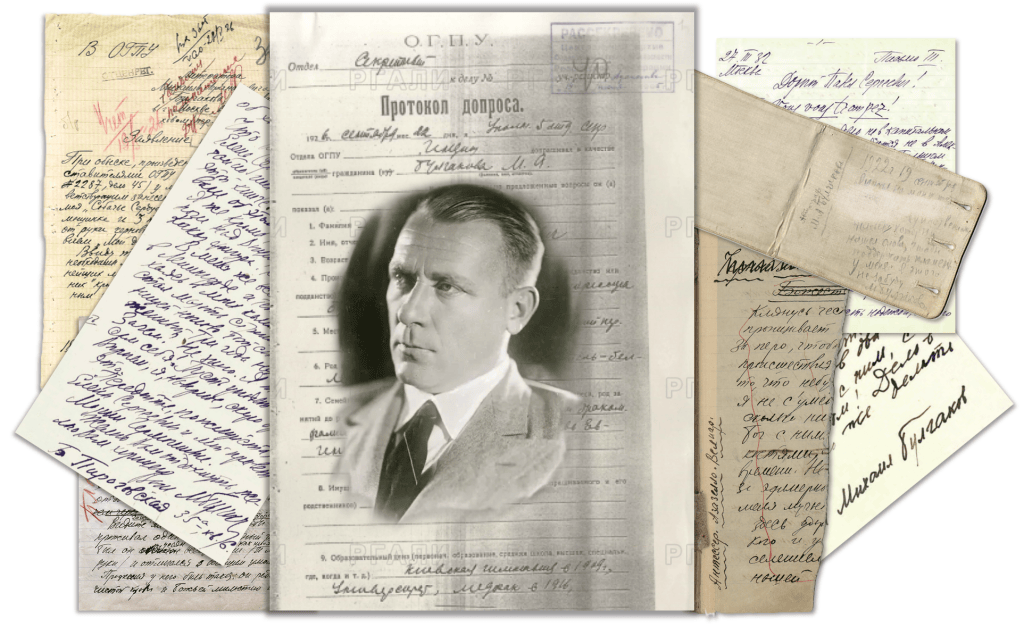
By the mid-1920s, fledgling author Mikhail Bulgakov was already a marked man in the eyes of Soviet authorities due to his critical and satirical views of the Bolshevik regime. In April 1926, agents from the OGPU (the Soviet secret police and erstwhile precursor to the KGB) raided his Moscow apartment. During their search, the authorities confiscated his personal, highly candid diaries, along with the manuscript for his brilliant, biting satirical novella ‘Heart of a Dog.’
Following the confiscation, Bulgakov was subjected to intense interrogations throughout 1926, but was still allowed to remain a free man. Unlike many of his contemporary literary peers who were arrested, exiled, or killed during the height of Soviet purges, Bulgakov managed to avoid imprisonment largely because Joseph Stalin was an admirer of his play ‘The Days of the Turbins.’ Regardless, traumatized by the invasion of his privacy, he immediately stopped keeping a diary, opting instead to confine his thoughts to letters or dictating notes to his wife, Elena.
The history behind the confiscation of Mikhail Bulgakov’s diaries is a dramatic story of state surveillance, creative defiance, and an ironic twist of fate that heavily inspired his masterpiece ‘The Master and Margarita.’ For three long years, authorities kept Bulgakov’s writing locked up and out of reach. Refusing to let the matter rest, throughout this period Bulgakov fiercely petitioned and lodged official complaints demanding the return of his personal property. Remarkably, in 1929, the secret police relented and returned both the manuscript of ‘Heart of a Dog’ and his diaries.
Still deeply unsettled by the ordeal and knowing his thoughts could easily be used to condemn him in the future, Bulgakov immediately threw his diaries into the fire, burning them to ashes. He believed he had permanently erased his private thoughts from the world. However, unbeknownst to Bulgakov, the OGPU had meticulously photocopied and transcribed the diaries before returning them. This historical episode directly birthed one of the most famous literary quotes in history. In ‘The Master and Margarita,’ the protagonist burns his own controversial novel in a stove out of despair, only for the devil (Woland) to hand it back to him perfectly intact, uttering the legendary phrase: “Manuscripts don’t burn.” Bulgakov wrote that line out of pure artistic conviction, never knowing that the Soviet secret police had proved it literally true with his own diaries.
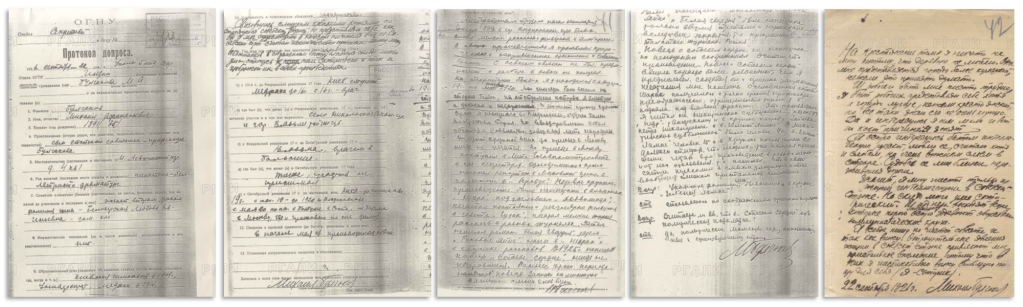
The following translation is taken from Bulgakov’s initial 22 September 1926 interrogation, mostly consisting of a questionnaire with pre-printed questions that Bulgakov was to fill in. Additional interrogation material presented is undated.
Naturally, the date of the interrogation—September 22—was not chosen at random, as the dress rehearsal for the play ‘The Days of the Turbins’ at the Moscow Art Theatre (MKhAT) was scheduled for September 23. Bulgakov’s enemies made one last desperate attempt to derail the production. But the writer was on his guard.
The following day, the dress rehearsal of ‘The Days of the Turbins’ went successfully, though the author was ultimately forced to part with a portion of the “Petliura” scene — specifically, the beating and death of a Jewish character. Despite Bulgakov’s furious protests, the scene was cut.
The OGPU prepared meticulously for Bulgakov’s interrogation, and he was placed under surveillance. In July 1926, an informant reported: “Regarding Bulgakov’s play ‘The White Guard,’ which is currently in rehearsal at the Art Theatre, there is considerable surprise in literary circles that the Repertoire Committee has cleared it for production, given that it possesses a distinct and unequivocal White Guard spirit.
“According to those who have heard the play, it is considered a rather powerful artistic work; through its strong, vividly rendered scenes, it clearly aims to elicit sympathy for the Whites who fought for their cause.
“Everyone acknowledges that the play has a distinct ideological slant. Writers who support the Soviet platform speak of the play with indignation, particularly outraged by the fact that it will evoke a certain sympathy for the Whites.
“As for anti-Soviet factions, there is great jubilation among them that the play managed to slip past a series of bureaucratic ‘hurdles’. This is stated openly.”
OGPU interrogation record, September 22, 1926
September 22, 1926
OGPU
Secret Department
INTERROGATION RECORD
September 22, 1926. I, Gendin, Authorized Agent of the 5th Section of the Secret Department of the OGPU, interrogated Citizen M. A. Bulgakov as an accused person (witness); in response to the initial questions put to him, he stated the following:
1. Surname: Bulgakov
2. First name and patronymic: Mikhail Afanasyevich
3. Age (year of birth): 1891
4. Origin (place of birth, parents, nationality, citizenship or subject status): Son of a State Councilor — Professor Bulgakov
5. Place of residence (permanent and most recent): 4 Maly Levshinsky Lane, Apt. 1
6. Occupation (most recent place of employment and position): Writer of fiction and playwright
7. Marital status (close relatives, their names, surnames, addresses, occupations before the revolution and recently): Married (second marriage). Wife’s surname: Belozerskaya, Lyubov Yevgenyevna—homemaker.
8. Property status (of the person being interrogated and their relatives, before and after the Revolution): None.
9. Educational background (primary education, secondary school, higher education, specialized training, where, when, etc.): Kyiv Gymnasium (1909); University, Medical Faculty (1916).
10. Party affiliation and political convictions: Non-party. Having become deeply rooted in Soviet Russia (currently under construction), I cannot imagine how I could exist as a writer outside of it. I consider the Soviet system to be exceptionally stable. I see many flaws in everyday modern life, and given the my mindset, I view them satirically and portray them as such in my works.
11. Where I lived, served, and what I did:
a) before the war of 1914.
b) from 1914 until the February Revolution of 1917. Kyiv; medical student until 1916; physician from 1916 onwards.
c) where I was and what I did during the February Revolution of 1917; whether I took an active part and what form that took. The village of Nikolskoye, Smolensk Province, and the town of Vyazma in the same province.
d) from the February Revolution of 1917 until the October Revolution of 1917. Vyazma; working as a hospital physician.
e) where I was and what I did during the October Revolution of 1917. The same, I took no part in it.
f) from the October Revolution of 1917 to the present day. Kyiv—until the end of August 1919; from August 1919 to 1920 in Vladikavkaz; from May 1920 to August in Batum, working for ROSTA; from Batum to Moscow, where I reside to this day.
12. Information regarding prior criminal convictions (before and after the October Revolution). A search was carried out in early May of this year.
13. Relationship of the witness being questioned to the accused.
Recorded accurately from my words; the record has been read to me (signature of the person being questioned).
Mikhail Bulgakov

Testimony regarding the substance of the case.
I began my literary work in the autumn of 1919 in the city of Vladikavkaz, under the Whites. I wrote short stories and feuilletons for the White press. In my works, I displayed a critical and hostile attitude toward Soviet Russia. I had no connection to Osvag, nor did I receive any offers to work for OSVAG. I was in White-controlled territory from August 1919 to February 1920. My sympathies lay entirely with the Whites; I viewed their retreat with horror and bewilderment. When the Red Army arrived, I was in Vladikavkaz, suffering from relapsing fever. Upon recovering, I began working for the Soviet authorities, heading the Literary Section (LITO) of the Department of Public Education (Narobraz). I did not publish any major works anywhere before arriving in Moscow. Upon arriving in Moscow, I joined the Literary Section of Glavpolitprosvet (Chief Committee for Political Education) as a secretary. At the same time, I began reporting work for the Moscow press, specifically for Pravda. My first major work, titled ‘Diaboliad,’ was published in the Nedra almanac; I also published serialized fiction regularly in the newspaper Gudok and short stories in various magazines. Subsequently, I wrote the novel ‘The White Guard,’ followed by ‘The Fatal Eggs’ — both published in Nedra and in a collection of stories. In 1925, I wrote the novella ‘Heart of a Dog,’ which was never published. Prior to this period, I wrote the novella ‘Notes on the Cuff.’
Recorded accurately from my words.
M. Bulgakov.

[Note: Top edge of the sheet cut off] … ‘Diaboliad’ and ‘The Fatal Eggs’ were published. ‘The White Guard’ was published only in part, two-thirds of it, and the printing was left unfinished due to the closure (that is, the discontinuation) of the thick journal Rossiya. The tale of ‘The Heart of a Dog’ was not published due to censorship. I believe that the work ‘The Heart of a Dog’ turned out to be far more vicious than I had intended when creating it, and I understand the reasons for the ban on its publication. Sharik, the dog transformed into a human, emerged, from Professor Preobrazhenskiy’s perspective, as a negative character, since he fell under the influence of a political faction. I read this work at the Nikitin Saturdays gatherings to Comrade Angarskiy (editor of Nedra), as well as at Pyotr Nikanorovich Zaitsev’s poets’ circle and at the “Green Lamp” society. There were about 40 people at the Nikitin Saturdays, about 15 at the “Green Lamp,” and about 20 at the poets’ circle. I must note that I repeatedly received invitations to read this work at various venues but declined them, as I realized I had gone too far with the satire’s viciousness and that the novella was attracting excessive scrutiny.
Question: Please name the individuals who attend the “Green Lamp” circle.
Answer: I refuse to do so on ethical grounds.
Q[uestion]: Do you consider ‘The Heart of a Dog’ to have a political subtext?
A[nswer]: Yes, there are political elements, elements which are opposed to the existing order.
M. Bulgakov.
I cannot write about peasant themes because I do not like the countryside. It strikes me as being far more dominated by kulaks than is commonly believed.
It is difficult for me to write about the lives of workers; although I have a better understanding of their way of life than that of the peasantry, I still do not know it very well. Moreover, I have little interest in it, and for this reason: I am busy. I am keenly interested in the life of the Russian intelligentsia; I love them and consider them a very important, albeit weak, stratum of society. Their fate is close to my heart, and their experiences matter deeply to me.
It follows that I can only write about the life of the intelligentsia in the Soviet state. Yet my mind is satirical by nature. My pen produces works that, at times, appear to deeply offend Communist social circles.
I always write with a clear conscience and exactly as I see things! The negative aspects of life in the Soviet state command my close attention because I instinctively see in them rich material for my work (I am a satirist).
September 22, 1926
Mikhail Bulgakov

