
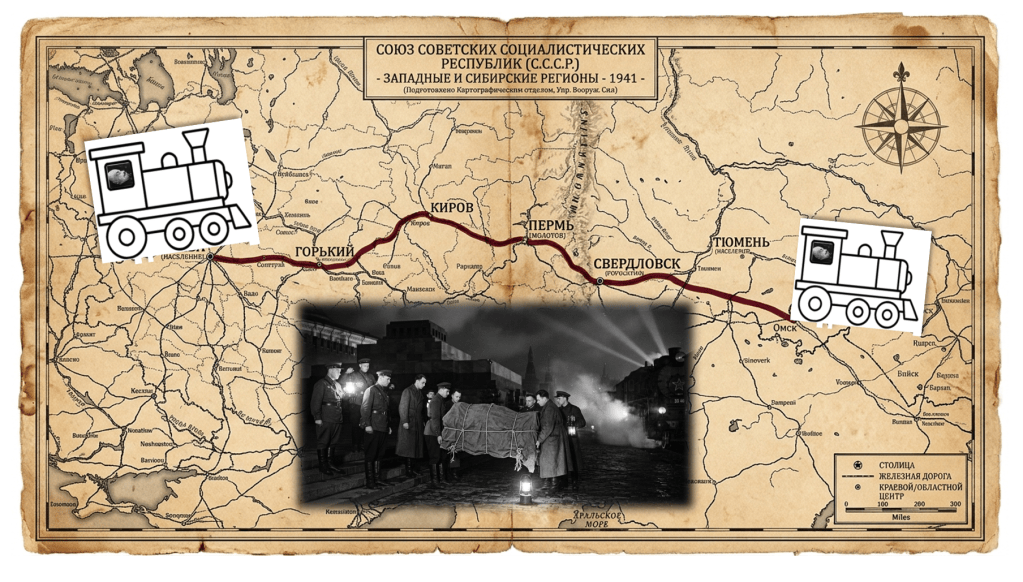
In 1941, one week after the German invasion of the USSR, the Soviet Politburo ordered that Vladimir Lenin’s embalmed remains be evacuated from Moscow to Tyumen, Siberia, to protect it from German bombing raids and the advancing Nazi forces during World War II. As the founder of the Soviet state, Lenin’s preserved body carried major ideological weight, making its potential destruction or capture a propaganda blow.
Red Square was transformed beyond recognition: plywood structures were erected, and a second story was built over the Mausoleum, completely camouflaging the area. While engineers proposed reinforcing the Red Square mausoleum itself and filling its central section with sand, officials ultimately rejected that plan in favor of moving the body far east to Tyumen.
A Moscow-based biochemist, Professor Boris Zbarsky, was urgently summoned by Soviet leadership. Comrade Molotov, who at the time served as the First Deputy Chairman, tasked the scientist with a difficult mission: preparing Lenin’s body for evacuation. The choice of Zbarsky was no accident; he had participated in the original embalming procedure and served as the head of the special laboratory attached to the Mausoleum. At that time, Zbarsky was directly responsible for maintaining the preservation of the body, a task he had been performing with great success. Now, however, the situation had changed, and Zbarsky was required to adapt to new demands.
The destination was Tyumen; Zbarsky and his laboratory staff were to accompany the “object” throughout the journey. This was the most logical course of action, as the professor needed to personally monitor the condition of the body and decide on the spot whether emergency measures were required.
A special panel was promptly established to inspect the train designated for the Moscow–Tyumen run. Every bolt and screw was checked, and a formal report on the train’s technical condition was drawn up, not by railway personnel, as was standard practice even for special transports, but by agents of the security services (the Chekists). In total, three trains were prepared. The first, carrying security personnel, traveled about one rail section ahead; the second (the primary train) carried the leader’s body, accompanied by laboratory staff and other support personnel. The third train also carried security personnel.
The second train was equipped with special shock absorbers and systems designed to maintain a low temperature and the necessary level of humidity. Zbarsky ordered the train to stop several times to ensure that this equipment was functioning correctly. By this point, Lenin’s body had remained in the mausoleum for 17 years without ever being moved; now, it had to be transported (first by vehicle, then by train) over a considerable distance and duration. Inside the mausoleum, the temperature was kept stable at no higher than 16°C (61°F), while outside the train, it was 37°C (99°F). One can only imagine the magnitude of the risk taken by those who assumed responsibility for transporting the remains.
THE ARRIVAL IN TYUMEN
The stops made by the special train were also kept secret; even station management was informed only when the train had already come to a halt on the platform. Since Tyumen lacked any “special” industrial or military facilities, the intense secrecy surrounding the site’s security sparked a flurry of rumors. Local residents were convinced that “Katyusha” rocket launchers were being manufactured in their city, yet it took only a few months for the entire town to learn that the Leader had been brought there. Ironically, the secret was inadvertently revealed by the Chekists themselves when they ordered a 1920s-style suit from a local tailor shop—without even requiring a fitting. That said, there are several theories as to how the information might have leaked.
Overall, the journey across the country proceeded without incident, and upon arrival, everything was in place and readied for the valuable cargo’s reception. In fact, not even the First Secretary of the City Committee knew exactly what was being brought to Tyumen; he had merely been warned that an “extremely important object” was being evacuated from Moscow. This was not particularly unusual, as more than 20 industrial enterprises had been relocated to Tyumen during the war.
It was only after the train arrived that it became known this “important object” was, in fact, the leader of the socialist revolution. The train was placed on an end platform under guard, while a search began for vacant buildings that could serve as a temporary mausoleum. Ultimately, they settled on an old structure located in the city center, enclosed by a high fence. The final decision rested entirely with Professor Zbarsky and the head of security, as the choice fell strictly within their purview.
The body was placed inside a former vocational school building, where Zbarsky, who had arrived with his family, also took up residence; he was tasked with ensuring the preservation of the body throughout the evacuation period. This was a complex and highly critical responsibility. Strict secrecy and constant surveillance were integral to the plan to safeguard the leader’s remains. Internal guards were drawn from the Kremlin security detail, while external security was entrusted to local security personnel in Tyumen. A full military unit was dispatched from Moscow to guarantee the safety of the leader’s body.
Today we’re presenting English translations of three documents related to the movement of the Lenin “mummy”. The first is the 3 July 1941 Soviet NKGB Order 00255 regarding the evacuation of the remains. The second, also dated 3 July 1941, certifies that the body was evacuated, along with Lenin’s heart, sections of his brain, and the bullet that was used in the attempt to assassinate Lenin in 1918. The third is a personal Top Secret “eyes only” report dated 18 July 1941 to Commissar for State Security Vsevolod Merkulov from the Omsk Oblast head of NKGB Directorate, documenting events immediately following the delivery of Lenin’s body.

Document 1:
Order of the NKGB of the USSR regarding the evacuation of the body of V. I. Lenin
July 3, 1941
Moscow
Top Secret
No. 00255
Pursuant to the decree of the Council of People’s Commissars of the USSR dated July 2, 1941, I HEREBY ORDER:
1. Comrade Shadrin, Deputy Chief of the 1st Department and Senior Major of State Security, shall organize the formation and dispatch of a special train.
2. Responsibility for the security of the special train during its transit shall be assigned to the Office of the Commandant of the Moscow Kremlin and the 1st Department of the NKGB of the USSR.
3. The Commandant of the Moscow Kremlin, Major General Spiridonov, shall assign 15 Red Army soldiers and 5 commanders from the NKGB Security Battalion to provide security for the special train during its transit and at its destination.
4. Lieutenant of State Security I. I. Kiryushin shall be appointed Chief of Security.
5. Comrade Shadrin, Deputy Chief of the 1st Department of the NKGB of the USSR, shall assign 5 operational officers and the necessary service personnel for the special train.
6. Captain of State Security K. P. Dukin shall be appointed Chief of the special train.
7. Lieutenants of State Security N. N. Komov and M. P. Eroshin shall be appointed as engineers for the special train.
8. The Chief of the 2nd Directorate, Commissar of State Security 3rd Rank Comrade Fedotov, shall ensure the unimpeded movement of the special train through all stations along its route on the Yaroslavl Railway line.
9. Approve the attached security instructions.
People’s Commissar of State Security of the USSR Merkulov
Central Archive of the RF FSB, F. 17, Op. 25, D. 10, l. 77-78

Document 2:
Act regarding the removal of V. I. Lenin’s body to Tyumen
July 3, 1941
Moscow
Top Secret
We, the undersigned — Commandant of the Moscow Kremlin, Major General N. K. Spiridonov; Deputy Chief of the 1st Department of the NKGB of the USSR, Senior Major of State Security D. N. Shadrin; Honored Scientist, Professor B. I. Zbarsky; and Commandant of the V. I. Lenin Mausoleum, Lieutenant of State Security I. I. Kiryushin — have drawn up this document to certify that, pursuant to Order No. 00255 of the People’s Commissar for State Security of the USSR, dated July 3, 1941, we removed the body of Vladimir Ilyich Lenin from the V. I. Lenin Mausoleum and placed it into a special carriage on a special train for evacuation deep into the country, to the city of Tyumen, to ensure the preservation of his remains.
In addition to Lenin’s body, we also took V. I. Lenin’s heart, a bullet, and specimens of his brain, which had been kept in Moscow. Also removed from the Mausoleum were the logbooks containing records of the procedures performed by the professors.
Commandant of the Moscow Kremlin N. Spiridonov
Honored Scientist Professor B. Zbarsky
Deputy Chief of the 1st Department of the NKGB of the USSR D. Shadrin
Central Archive of the RF FSB, F. 17, Op. 25, D. 10, l. 86

Document 3:
Memorandum from the Head of the NKGB Directorate for the Omsk Region regarding the selection of premises and the creation of conditions for the preservation of V. I. Lenin’s body
18 July 1941
Top Secret
Eyes Only
No. 1923
TO THE PEOPLE’S COMMISSAR FOR STATE SECURITY, COMMISSAR FOR STATE SECURITY, 3RD RANK Comrade V. N. MERKULOV
Further to my telephone message, I report the following: Comrade Zbarsky arrived at the designated location on July 7, 1941, at 9:05 a.m. Moscow time. Upon his arrival, Comrade Zbarsky expressed a desire to move from this specifically designated location to somewhere else. This sentiment stemmed from a comparison between the conditions he had previously enjoyed and the conditions at his new location, conditions he had not yet truly examined, and which he could not immediately believe could be established in short order.
On the morning of July 8, 1941, I flew to their location. Together with Comrade Zbarsky, I examined and studied in minute detail the existing conditions, as well as the requirements for Comrade Zbarsky’s accommodation and his ongoing work.
As a result of our thorough and mutual assessment of the local situation, all the issues raised by Comrade Zbarsky were successfully addressed. By common consent, we reached a conclusion that everything necessary is in place to provide him with suitable accommodation and the means to continue his work.
By agreement with the First Secretary of the Regional Committee of the All-Union Communist Party (Bolsheviks), Comrade Kudinov, a separate, two-story stone building, well-isolated from the surrounding population, has been allocated for Comrade Zbarsky.
In his assessment, the building is entirely suitable for accommodating his entire group.
Over the course of two days, certain shortcomings in the designated premises were addressed, and measures were taken to establish basic conditions suitable for initial occupancy.
Late in the evening on July 9, 1941, the relocation to the designated premises was carried out. The move proceeded quite successfully, without any of the complications that had been feared due to the poor condition of the access road.
The relocation also failed to spark any discussion or speculation amongst the local population. The assigned building provided ample space for the entire group to be comfortably accommodated for both their work and their permanent residence.
To secure the building from the outside, two 24-hour police posts have been established. Furthermore, I have assigned a three-person team of undercover agents from the 3rd Department to monitor the surrounding population and systematically identify any rumors circulating in public or other spaces regarding the building’s new occupants.
Since the relocation, we’ve detected no talk or gossip concerning this building.
To manage and practically resolve all logistical and operational matters, including the outfitting of the building and the group’s ongoing support, I have posted a specialist from the KGB Directorate, as well as an official tasked with management of the accounting and financial affairs.
In order to ensure proper living and working conditions for Comrade Zbarsky, we are currently completing a series of repairs and construction work within the designated building.
Through the First Secretary of the Regional Party Committee, two vehicles have been placed at our disposal: a 1.5-ton GAZ-AA truck and an M-1 passenger car, both assigned to support the facility in question.
In the building allocated for this purpose, we have set up a kitchen and a dining area, and have organized catering for the entire team. The necessary food supplies have been allocated for this purpose. The kitchen and dining staff were selected through the City Party Committee from among vetted Communists. Furthermore, we have conducted a thorough background check on them and granted the appropriate security clearances. The personnel brought in to service the facility have no knowledge of the nature of the work being conducted by Comrade Zbarsky’s team.
Comrade Zbarsky has briefed his team on the expected code of conduct at the new location.
The following officials have been made aware of the nature of Comrade Zbarsky’s work: the head of the city branch of the NKGB, the head of the city branch of the NKVD, the secretary of the City Party Committee, the chairman of the City Council, and two officers from the NKGB Directorate who were seconded to assist in organizing this operation. I have cautioned and instructed all of them regarding their conduct from this point on.
I have issued specific directives to the head of the city branch of the NKGB to provide Comrade Zbarsky with ongoing practical assistance in his work and to ensure comprehensive operational and security support for the facility.
Following the trip to the site on July 12, 1941, Comrade Zbarsky and I have drawn up a detailed plan of measures, calculations, and cost estimates related to the equipping and renovation of the building, as well as the maintenance of Zbarsky’s entire staff up to January 1, 1942 (the cost estimate is attached).
[Translator note: The cost estimate is not attached to the document as found in the archive.]
To cover the expenses associated with all this work, I have placed 200,000 rubles, drawn from the funds of the NKGB Directorate, at the disposal of the head of the local NKGB city department.
Comrade People’s Commissar, in sending this detailed report, my intention is to apprise you of the local situation and the work we have carried out, and continue to carry out, to establish the necessary conditions for Comrade Zbarsky’s activities. I am also submitting an estimated budget for these expenses and request your instructions regarding the procedure for their disbursement. Henceforth, in accordance with your directives, I shall submit informational memoranda on this matter twice a month.
According to Comrade Zbarsky, his work is progressing excellently.
The conditions established and the measures we have taken guarantee the fulfillment of the government’s directives.
HEAD OF THE NKGB DIRECTORATE FOR THE OMSK OBLAST, CAPTAIN OF STATE SECURITY ZAKHAROV
Central Archive of the RF FSB, F. 17, Op. 25, D. 10, l. 66–70.

Translation © 2026 by Michael Estes and TranslatingHistory.org

