
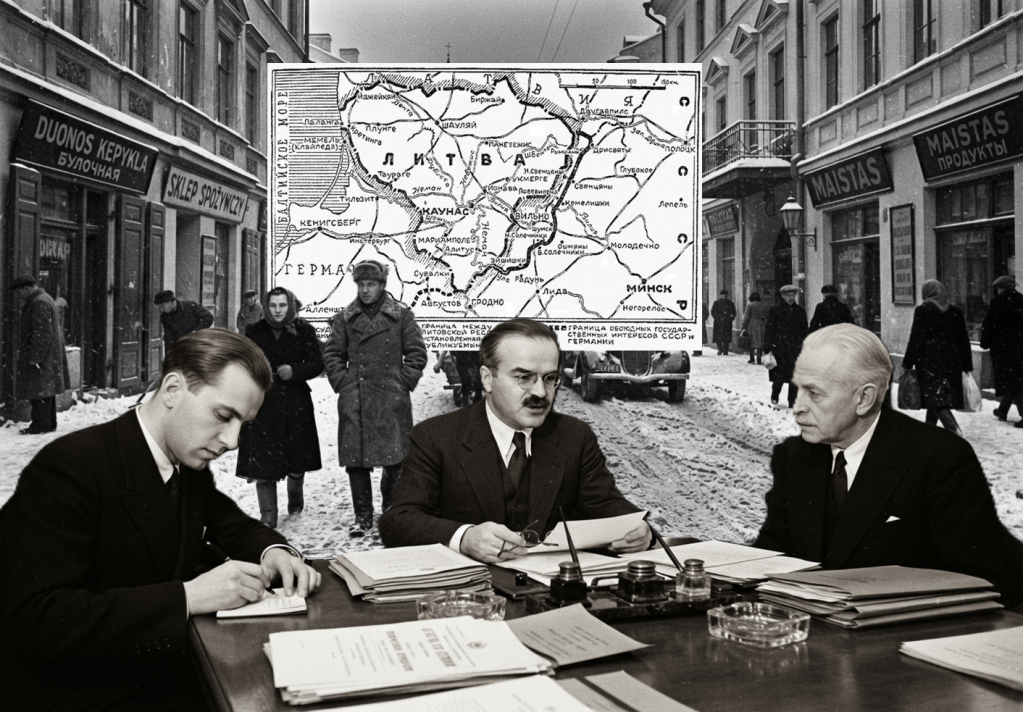
On 8 January 1941, a meeting was held in Moscow between Soviet Foreign Minister Vyacheslav Molotov, German Ambassador Friedrich-Werner von der Schulenburg, and German trade negotiator Karl Schnurre. During the meeting, the three finalized the Soviet Union’s purchase of the Lithuanian Strip (also known as the Suwałki Strip) from Nazi Germany. This negotiation removed the final territorial dispute between Berlin and Moscow just two days before they signed a sweeping border and commercial pact. The meeting was documented in Molotov’s Top Secret diary entry with the pithy statement that the meeting itself only lasted 12 minutes.
Historical context: Under the German–Soviet Boundary and Friendship Treaty of September 1939, Germany agreed to place Lithuania in the Soviet sphere of influence. In exchange, Nazi Germany reserved a narrow strip of southwestern Lithuania, west of the Šešupė River, for itself. In June 1940, the Soviet Red Army occupied and annexed all of Lithuania, including the strip promised to Germany. Moscow initially agreed to leave the strip unfortified, but Joseph Stalin soon sought to buy out Germany’s claim to secure full control of the Baltic border.
By late 1940, bilateral relations had grown tense following inconclusive Axis talks in Berlin. Karl Schnurre was in Moscow attempting to finalize a massive new economic agreement, which Moscow tied directly to resolving the Lithuanian border question.
The 8 January 1941 Meeting: Molotov summoned Schulenburg and Schnurre to reach a final settlement on the compensation Germany demanded for relinquishing its claim to the Lithuanian territory. Having Schnurre present underscored that the territorial transfer was intertwined with broader economic concessions. Moscow was willing to pay cash and expand raw material deliveries to keep Germany satisfied and maintain the appearance of a stable partnership.
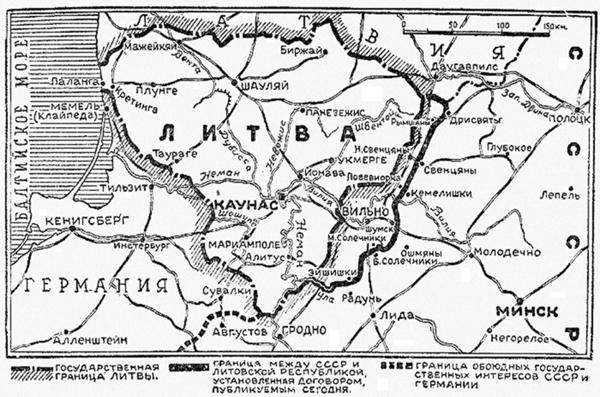
Impact: Two days after the meeting, Molotov and Schulenburg signed the German–Soviet Border and Commercial Agreement. Germany formally renounced its claim to the Lithuanian Strip in exchange for 7.5 million US dollars (31.5 million Reichsmarks), paid largely in gold and non-ferrous metals. Alongside the border settlement, the Soviet Union agreed to deliver 2.5 million tons of grain and 1 million tons of oil to Germany through August 1942. It also resolved compensation for German property in the Baltic states and regulated the resettlement of ethnic Germans.
And yet… For Hitler, however, the agreement was purely tactical. He had already signed Directive No. 21 for Operation Barbarossa in December 1940, and ceding the strip allowed Germany to extract vital Soviet raw materials while lulling Stalin into a false sense of security before the German invasion of the Soviet Union on 22 June 1941.
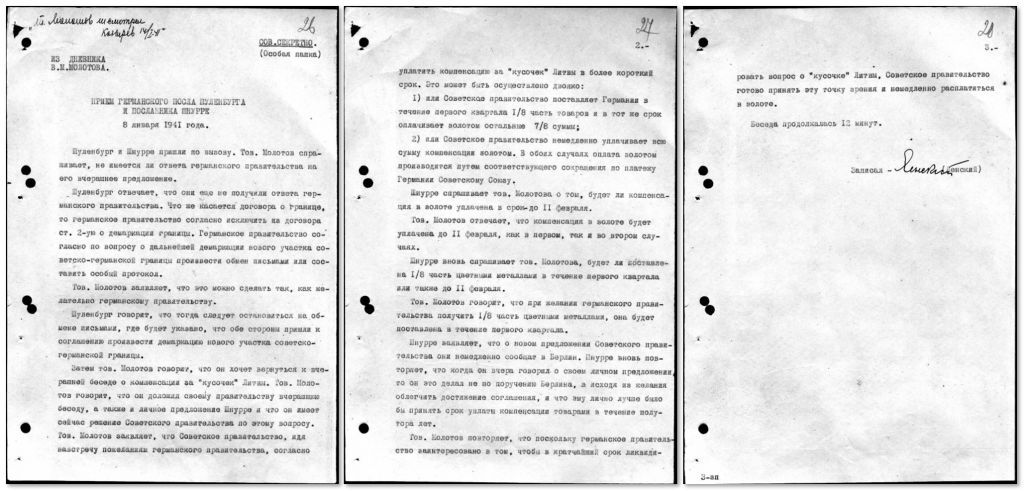
The following is a translation of Molotiv’s Top Secret 8 January 1941 diary entry (illustrated above). A brief note about the translation: the Russian word кусок [kusok] is treated to the diminutive form кусочек [kusochek], possibly to infer – through its use – that the Soviets view it as an almost trivial slice of land that wouldn’t be worth the Germans haggling over.

TOP SECRET
(Special Folder)
FROM THE DIARY OF V.M. MOLOTOV
MEETING WITH GERMAN AMBASSADOR SCHULENBERG AND ENVOY SCHNURRE
8 January 1941
Schulenberg and Schnurre arrived as requested. Comrade Molotov asked if they had received a response from the German government to his proposal of the previous day.
Schulenberg answered that they had not yet received a response from the German government. As for the border treaty, the German government agrees to exclude the 2nd article regarding a demarcation of the border from the treaty. The German government agrees, regarding the question of the further demarcation of a new section of the Soviet-German border, to exchange letters or draw up a special protocol.
Comrade Molotov noted that this can be done in any manner that the German government might prefer.
Schulenberg offered that they should then focus on the exchange of letters, wherein it should be noted that both sides had arrived at an agreement to carry out a demarcation of a new section of the Soviet-German border.
At that point, Comrade Molotov stated that he would like to return to the previous day’s conversation, particularly that part which dealt with compensation for a “piece” of Lithuania. Comrade Molotov said that he had reported the conversation to his own leadership, as well as Schnurre’s personal proposal, and that he now had the Soviet government’s solution to this question. Comrade Molotov stated that the Soviet government, meeting the German government halfway, agrees to pay compensation for the “piece” of Lithuania on quicker terms. This can be carried out in one of two ways:
1) either the Soviet government supplies Germany with 1/8 of the goods during the first quarter and, within the same period, pays for the remaining 7/8 of the total amount in gold,
2) or the Soviet government immediately pays the entire compensation amount in gold. In both cases, payment in gold is effected through a corresponding reduction in the payment to be made by Germany to the Soviet Union.
Schnurre asked Comrade Molotov if the compensation in gold would be paid before 11 February.
Comrade Molotov responded that the compensation in gold would be paid by 11 February in both cases.
Schnurre then inquired as to whether the 1/8 of the goods consisting of non-ferrous metals be delivered during the first quarter, or also by 11 February.
Comrade Molotov stated that, should the German government wish to receive 1/8 of the goods in the form of non-ferrous metals, this portion would be delivered within the first quarter.
Schnurre declared that he would immediately communicate the new proposal from the Soviet government to Berlin. Schnurre again repeated that when he had been discussing his personal preferences on the previous day, he was doing so not on instructions from Berlin, but motivated by the desire to facilitate an agreement, and that he personally would have found it better to accept one and a half years as a payment period in the form of goods.
Comrade Molotov repeated that since the German government had appeared interested in resolving the issue of the “piece” of Lithuania as quickly as possible, the Soviet government was prepared to adopt this point of view and make immediate payment in gold.
The conversation lasted 12 minutes.
recorded by Lenskiy [signature]
Translation © 2026 by Michael Estes and TranslatingHistory.org

