
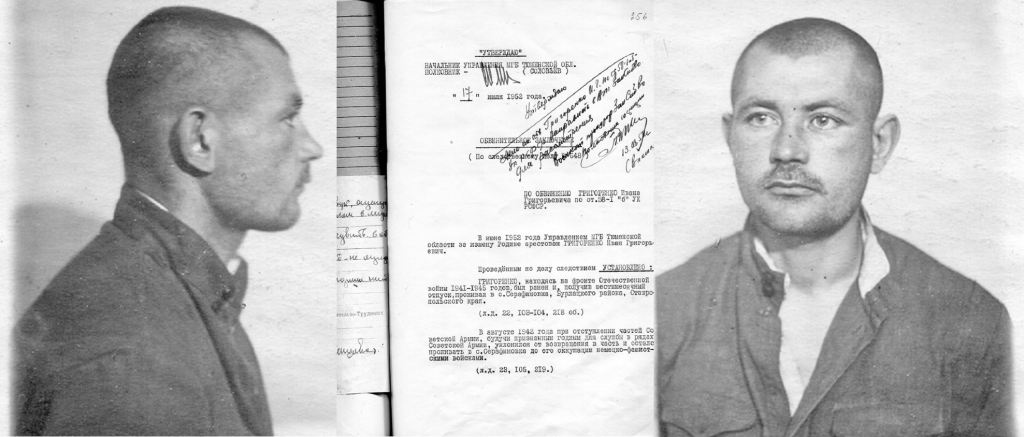
There’ll likely never be a consensus on the exact tally of Soviets executed for treason during World War 2. However, there is no doubt about two things: the number is in the six-figure range, and as many as half of them were wrongfully executed. There is also no doubt that, as we crawl along in the eighth decade following the end of that brutal war, declassified documents continue to tumble from the holdings of the former Soviet Union’s most classified archives.
One such former Top Secret document saw the light of day on 14 May 2026. It is one of many archival documents covering the period from 1949 to 1953 released by the Regional Directorate of the FSB of Russia for the Tyumen Region.
These materials, brought together under the auspices of Projects “Obelisk” and “No Statute of Limitations,” continue to shed light on the activities of Nazi collaborators — former police officers, village elders, and death squad members. Drawing upon these documents, our translators have amassed our own massive catalog of articles concerning dangerous state criminals who defected to the enemy during World War II.
Today we’ve come across the story of Private Ivan Grigoryevich Grigorenko, born in 1925, a native of the village of Brateshki in the Poltava Oblast. He was arrested in June 1952 on grounds of treason he committed ten years prior. For his crimes, he was sentenced by a military tribunal one month later to the maximum punishment — execution by firing squad — and confiscation of his property.
The court established that Ivan Grigorenko, a serviceman in the Soviet Red Army, found himself in the village of Serafimovka, Stavropol Krai, while on convalescent leave for a combat injury. Shortly afterwards, the village was captured by German forces. Instead of returning to his unit, Grigorenko remained in the occupied settlement.
The case materials indicate that in August 1942, at the suggestion of local police chief Kovalenko, Grigorenko voluntarily entered the service of the German police. He held the position of investigator until December of that same year. Having sworn an oath of allegiance to the occupying authorities, he was provided with a horse and issued a weapon and ammunition. From that moment on, he actively participated in punitive actions against the civilian population.
In September 1942, in the vicinity of the village of Serafimovka, he assisted the police in detaining a group of 20 to 25 people of Jewish ethnicity, and subsequently participated in their execution by firing squad.
“The police arrested two large Jewish families. I don’t recall their surnames, but I know that the head of one of them was a shoemaker. In the other family, I knew a girl named Rosa — she was a friend of mine — though I don’t remember her surname either. When we went to their home, not everyone was there. That evening, Rosa and her sister went to the police station, and they, too, were arrested,” Grigorenko stated during his interrogation.
Following the execution, as a token of gratitude, Grigorenko received the belongings of the executed: three dresses, felt boots, materials for making women’s shoes, a bedspread, and a watch.
“I myself aimed my rifle at the Soviet citizens of Jewish ethnicity standing before me and fired. I fired three shots, but I am unable to state exactly how many people I killed, as I was not the only one shooting. When the victims fell into the pit, there were still some among them who were alive; they were finished off,” the defendant recalled.
Furthermore, in his capacity as an investigator, Grigorenko maintained records of Komsomol members, interrogated them, and participated in searches and seizures of property from residents of the village of Serafimovka. He also traveled twice to neighboring villages to conduct raids against partisans.
In November 1942, he was recruited as a secret agent by a Gestapo representative identified in the documents as O.G. Khaustov. Grigorenko was tasked with identifying and reporting on the activities of communists, partisans, and their accomplices.
During the trial, Ivan Grigorenko stated, “I understand the nature of the charges brought against me. I plead guilty only in part — to participating in the execution of Soviet citizens. As to the remainder of the charges, I do not admit my guilt.”
He explained his actions by stating that he had no opportunity to leave the territory under occupation.
However, the preliminary investigation revealed no attempts by Grigorenko to defect to the Soviet forces or members of the Soviet underground. On the contrary, his active and deliberate assistance to the occupation authorities, as well as his personal involvement in the arrests and executions of Soviet citizens of Jewish origin, including the misappropriation of their property, are corroborated by the testimony of witnesses M.A. Yemelyanov, O.G. Khaustov, and V.P. Shcherbakov.
The defendant did not contest the fact that he had committed unlawful acts, neither during the investigation stage nor during the trial. The only objective he sought in his writ of appeal was a mitigation of the sentence imposed upon him.
The Court, guided by the clarifications issued by the Plenum of the Supreme Court of the USSR No. 22/M/16/U/ss dated November 25, 1943, titled “On the Classification of the Actions of Soviet Citizens Rendering Assistance to the Enemy in Areas Temporarily Occupied by German Invaders,” correctly characterized Ivan Grigorenko’s criminal actions as treason against the Motherland, falling under Article 58-1b of the Criminal Code of the RSFSR.
“The evidence gathered and presented irrefutably confirmed Ivan Grigorievich’s guilt, and his conviction for treason against the Motherland was fully justified. In light of all the circumstances of the case, the imposition of the supreme penalty was a just sentence. Accordingly, no grounds are discernible for challenging the judgment rendered in the case of I.G. Grigorenko.”
Grigorenko was executed shortly after the verdict was read.

Translation © 2026 by Michael Estes and TranslatingHistory.org

