
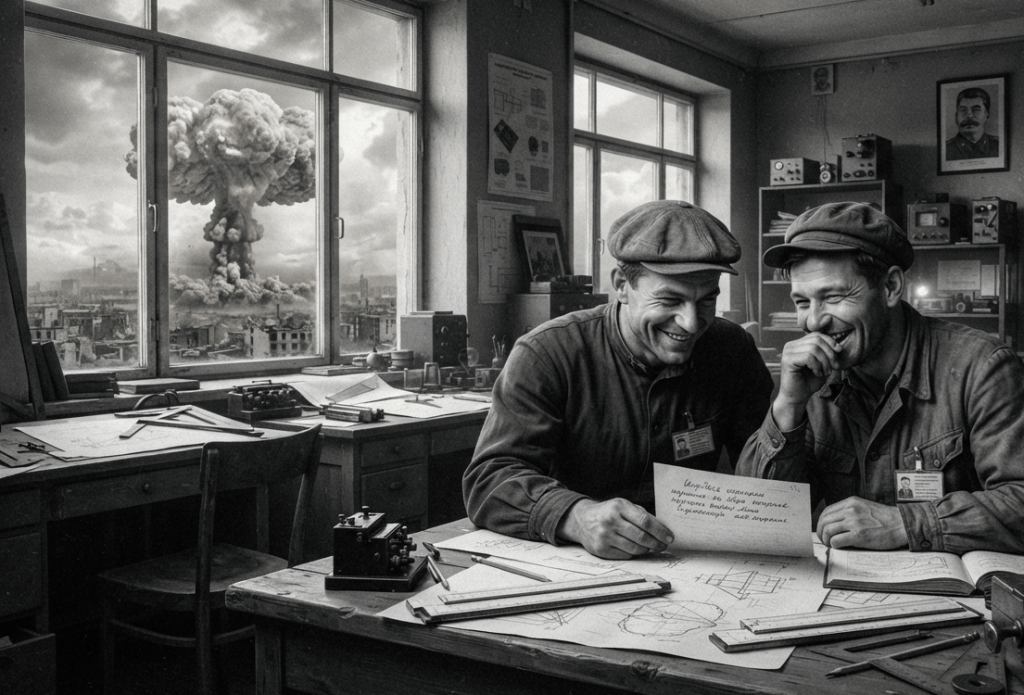
In October 1940, two young Soviet physicists named Viktor Maslov and Vladimir Shpinel, working at the Ukrainian Institute of Physics and Technology (UFTI) in Kharkiv, submitted a revolutionary invention claim titled “On the Use of Uranium as an Explosive and Toxic Agent.” This proposal would come to be recognized as the first valid technical design for an atomic bomb in the Soviet Union.
Maslov and Shpinel were the first Soviet scientists to propose a mechanism that used conventional explosives to rapidly force subcritical masses of Uranium-235 together into a supercritical mass, initiating a runaway nuclear chain reaction.
Working independently and under strict isolation, their conceptual design was submitted on lines remarkably similar to the British Frisch–Peierls memorandum (March 1940), well before the American Manhattan Project or the official Soviet bomb program took shape.
Despite their breakthrough, the proposal was harshly dismissed and criticized by senior Soviet physics elites, including Vitaly Khlopin, Pyotr Kapitsa, and Abram Ioffe, who viewed the idea of a nuclear weapon as practically impossible or a matter for the distant future. This, in spite of the red meat offered in the physicists’ assertion that a uranium bomb could wipe out the likes of cities such as London and Berlin, and that the bombs could have lingering effects due to the resulting invisible and odorless radioactive agents dispersed throughout the atmosphere (the author of the patent’s rejection even stated in the document that he did not understand the concept of radioactivity).
Because of this rejection, the Soviet state ignored their proposal. It was not until 1946, after the end of World War II and the American bombings of Hiroshima and Nagasaki, that the Soviet government finally recognized the validity of their work and officially granted them an invention patent. However, by that time, the actual Soviet atomic bomb project (led by Igor Kurchatov) was already built entirely on an implosion design obtained through espionage from the Manhattan Project.
We’ve translated two Secret documents relating to this historical blunder, and present them to you intact. The first is the patent application itself, and the second is the response (“Conclusion”) from the Scientific Research Institute of Chemical Defense Department “A”, which was forwarded to the Directorate of Military Chemical Defense, effectively putting a nail in the coffin of the physicists’ efforts.

Document 1: Patent application by V.A. Maslov and V.S. Shpinel: “On the Use of Uranium as an Explosive and Toxic Agent”
17 October 1940
Secret [hand-written by Maslov]
As is well known, according to the latest findings in physics, an explosion of colossal destructive power can occur in sufficiently large quantities of uranium, specifically when the dimensions of the uranium block significantly exceed the mean free path of neutrons within it. This is due to the extremely high rate at which the nuclear fission chain reaction develops in the uranium and the enormous amount of energy released in the process (this energy is a million times greater than that released during the chemical reactions of conventional explosions).
However, the difficulty in producing an explosion in uranium lies in the fact that, as the quantity of uranium increases — and well before the mass becomes large enough for its dimensions to significantly exceed the neutron mean free path (thereby creating the conditions for an explosion) — a non-explosive chain reaction will begin within the uranium mass.
This non-explosive chain reaction, which occurs when the uranium reaches a certain critical volume (specifically, when the neutron mean free path is comparable to the linear dimensions of the uranium mass), leads to a phenomenon of thermal self-regulation that prevents an explosion.
Thus, to create the conditions for an explosion, it is necessary to cross the critical volume threshold in a time shorter than that required for the chain reaction to develop. In a paper investigating the conditions for the onset of a chain reaction in uranium (ZhETF [Journal of Experimental and Theoretical Physics], 1940, Vol. 10, No. 5), Khariton and Zeldovich write: “It is unlikely that the duration of the processes bringing about the transition from critical conditions — for example, the time required to bring together two uranium masses, each of which is in a subcritical state with respect to chain fission — could be made even comparable to the reaction buildup time.”
It is shown below that it is possible to produce an explosion in uranium, and the method is indicated.
It follows from the foregoing that the problem of producing an explosion in uranium reduces to creating, within a short period of time, a mass of uranium significantly exceeding the critical mass.
We propose achieving this by filling a vessel, divided by neutron-impermeable partitions, with uranium in such a way that each individual isolated volume (or section) contains a subcritical amount of uranium. Once the vessel is filled, the partitions are removed via an explosion; this results in a total uranium mass significantly exceeding the critical mass, triggering an instantaneous uranium explosion. Explosives such as silver acetylide may be used for the partitions. Such compounds do not produce gaseous by-products; consequently, their detonation causes the partitions to vaporize without scattering the uranium.
The following design serves as an example of the implementation of this principle. A uranium bomb could take the form of a sphere divided internally into pyramidal sectors, with their vertices at the center of the sphere and their bases on its surface. These sector-chambers could contain an amount of uranium just slightly less than the critical mass. The chamber walls would need to be hollow and contain water or another hydrogen-bearing substance (e.g., paraffin, etc.). The surfaces of the walls would need to be coated with an explosive substance containing cadmium, mercury, or boron, elements that strongly absorb neutrons slowed down by the water layer (such as cadmium acetylide). The presence of even a very small quantity of these substances, combined with the water layer, would make it completely impossible for neutrons to pass from one chamber to another, thereby preventing the initiation of a chain reaction within the sphere. At the desired moment, a mechanism could be used to detonate the intermediate layers at the center of the sphere. Since detonation velocities can reach thousands of meters per second, in a time shorter than 10-3 seconds, as a result of the volatilization of the layer containing cadmium, boron, or mercury, a supercritical volume of uranium will be formed. This rate is quite sufficient to prevent the onset of a chain reaction and, consequently, to prevent the phenomenon of thermal self-regulation as the uranium passes through the critical volume.
Therefore, the onset of the explosion of the partitions (even before they are completely blown apart) will trigger the explosion of the entire uranium mass. The capacity of such a bomb can easily be increased by enlarging its radius — accompanied, of course, by a corresponding increase in the total number of these chamber-sectors — since the volume of the latter cannot exceed a certain size determined by critical conditions.
It should be noted that the design described is not the only possible one. For instance, there is no requirement to use only those explosives that do not produce gaseous products to detonate the partitions; if the latter were used, they would simply need to be placed along the partitions within armored chambers to prevent the uranium from being scattered. The armor for these chambers could be of any thickness, as iron is virtually transparent to neutrons.
Regarding a uranium explosion, in addition to its colossal destructive power (constructing a uranium bomb capable of destroying cities such as London or Berlin would evidently pose no problem), one must note another extremely important characteristic. The products of a uranium bomb explosion are radioactive substances. These possess toxic properties thousands of times more potent than the strongest poisons (and, consequently, conventional chemical warfare agents). Therefore, considering that for some time after the explosion they exist in a gaseous state and disperse over a vast area, retaining their properties for a relatively long period (on the order of hours, with some lasting even days or weeks), it is difficult to say which aspect of uranium explosions (their colossal destructive power or their toxic properties) is more militarily attractive.
Note: A characteristic feature of these radioactive toxic agents is the difficulty of detecting them, as they are predominantly odorless solids. Their effects are also delayed and resemble those of mustard gas, manifesting after an even longer interval — though this applies, of course, to cases of skin contact rather than ingestion, as the lethal dose is very small in the latter instance.
Uranium explosions will also possess other features unique to them such as neutron fluxes, hydrogen streams (should the bomb detonate in water), and so forth, which we can discuss in greater detail if necessary, just as we can other aspects of the issue of uranium explosions.
Candidate of Physical and Mathematical Sciences V. Maslov
Candidate of Physical and Mathematical Sciences V. Shpinel
The authors are staff members of the Physical-Technical Research Institute of the Academy of Sciences of the Ukrainian SSR (Kharkiv, Yumovsky Tupik, FTI); Kharkiv, Prospekt Pravdy, “Krasny Promyshlennik” Building, Entrance 1, Apt. 4; until November 27 — Moscow, Krymsky Val, No. 10/16, Apt. 76.
AP RF. F. 93, d. 21 (46), l. 293-296

Document 2: Conclusion of the Scientific Research Institute of Chemical Defense (NIKHI) of the USSR NKO [People’s Commissariat for Defense] regarding patent applications from UFTI [Ukrainian Institute of Physics and Technology] staff, sent to the Directorate of Military Chemical Defense
[Undated, transmitted no earlier than 21 January 1941]
Secret
The first of the proposals offered, a multi-chamber centrifuge, appears sound in concept and feasible in principle. However, it is unlikely that centrifugation — even when enhanced by circulation — would prove superior to the universally adopted method of separation via thermal diffusion (see, for example, Physical Review 56, p. 266, 1939). While the proposal is original, it holds no particular military interest.
[Note: The article referenced in the previous paragraph was published by J.W. Beams and C. Skarstrom, The Concentration of Isotopes by the Evaporative Centrifuge Method].
The second proposal, “On the Use of Uranium as an Explosive and Toxic Agent,” is considerably less serious. The authors propose detonating the gaps between uranium blocks, thereby rapidly creating a supercritical mass of uranium. However, the article by Khariton and Zeldovich (Journal of Experimental and Theoretical Physics, Vol. 10, Issue 5), cited by the authors of the proposal, points out a number of factors that inhibit the explosion of the entire mass and are highly significant near critical conditions (uranium consumption, the appearance of new nuclei, a delay in the release of some neutrons, thermal expansion, etc.). Crucially, some of these inhibiting factors arise at the same rate as the uranium explosion itself. Consequently, the entire block will not explode simultaneously. If the heat generated does not have time to dissipate and instead causes the bomb to shatter into fragments, the individual pieces will be subcritical and will not explode. As for the use of uranium fission as a toxic agent, this proposal by the authors is unclear and entirely unsubstantiated.
Thus, the authors’ proposal is, on the whole, of no interest to the field of military chemistry. Nothing said above is intended to oppose scientific work on uranium explosions; it concerns only their current practical significance for defense chemistry.
Head of Department “A,” NIKHI KA: Military Engineer 2nd Rank Sominsky
Conclusion prepared by Professor A. Zhukhovitsky
AP RF. F. 93, l. 21 (46), l. 280-281

Translation © 2026 by Michael Estes and TranslatingHistory.org

