
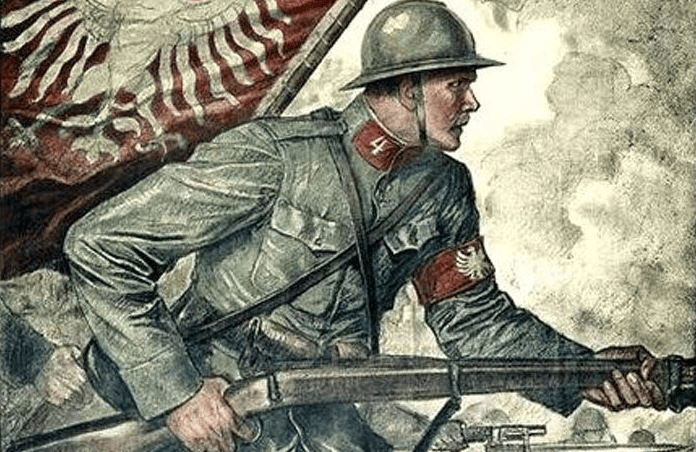
We can thank Carl von Clausewitz for the concept of the fog of war. But leave it to the Red Army to provide us with shining examples of the fog of logistics, which may have come close to derailing what otherwise should have been a walk-in-the-park invasion of Poland in 1939. Toss in a subsequent (and deadly) lack of discipline, and you’ve got the makings for some sloppy military order.
We’ve selected five classified reports from September and early October 1939 that shed light on the confusion that must have been running rampant up and down the Ukrainian Front, for starters. In one case (Document 1), maps supplied to the forces would only get them as far as Lviv. Pleas were dispatched to the Chief of Staff, as the Reds were supposed to advance at least 100 km west of Lviv to the San River. The second document captures bad intelligence (word had incorrectly come down that the bridge at Rava-Ruska had been blown up) and that the comms center in Lviv was not up to snuff. The third document underscores the lack of discipline, a penchant for laziness, and an all-but-absent command and control that resulted in a number of friendly aircraft being brought down by Soviet ground troops. The fourth document again presses home the need for reliable communications; it spells out, in almost embarrassing detail, how communications are meant to flow and how they WILL flow, and whose heads will roll if they do not. Finally, our fifth document is a call-back to the lack of discipline among the troops, when prisoners were summarily (and unlawfully) executed and shady civilians were attacked (and also shot). No mention was made of the nationalities of the victims of these events, but their characterization as “unauthorized conduct” suggests they were most likely Poles.
As with most of our translations on this site, the following five appear here in English for the first time. We’ll be bringing forward additional translations of documents from the amazing Polish cache of documents we were so fortunate to stumble upon.

Document 1:
SECRET
TO THE CHIEF OF STAFF OF THE UKRAINIAN FRONT, DIVISION COMMANDER Comrade BATUTIN
23 September 1939
I am reporting to you on the critical situation regarding maps among the troops. Corps commanders stated that the mobilization reserve maps only go so far as Lviv — there are no maps beyond that point.
From company commanders up to and including the division headquarters, the command personnel will conduct the march without maps. This situation cannot be considered normal.
I request that the troops be supplied with maps.
CHIEF OF STAFF OF THE EASTERN ARMY GROUP BRIGADE COMMANDER SAVINOV
MILITARY COMMISSAR OF THE EASTERN ARMY GROUP MAJOR ZOLOTUKHIN
CHIEF OF DEPARTMENT 1 MAJOR VEYALKO

Document 2:
TOP SECRET
[Undated]
TO DEPUTY CHIEF OF STAFF OF THE FRONT, BRIGADE COMMANDER ZLOBIN
1. According to a report from the Chief of Staff of the 6th Rifle Corps, there was no explosion of the bridge at Rava-Ruska. Reconnaissance regarding this matter is being conducted within a 15-km radius of Rava-Ruska. I will report the results.
2. The Germans in the area of the 96th Infantry Division have no orders to advance beyond the San River. They will presumably begin tomorrow. Major VEYALKO is conducting negotiations in Przemyśl.
3. Instructions regarding the protection of railway and highway facilities have been issued to the corps.
4. Instructions are being issued to the corps: a) regarding the construction of field defensive fortifications (command posts, strongpoints, and firing positions for machine guns and artillery) in outpost security areas; and b) regarding reconnaissance of defensive lines (battalion areas, regimental sectors, and divisional zones).
5. I would like to draw your attention to the poor performance of the Lviv communications center; it frequently causes service interruptions.
CHIEF OF STAFF OF THE 6th ARMY BRIGADE COMMANDER SAVINOV
COMMISSAR OF 6th ARMY HEADQUARTERS MAJOR ZOLOTUKHIN

Document 3:
TOP SECRET
ORDER
TO UKRAINIAN FRONT FORCES
26 September 1939 Ternopil
CONTENTS: Experience of combat operations
Combat experience from recent days has revealed an extreme lack of discipline and organization, as well as a failure of command and control on the part of officers, whenever aircraft appeared over troop positions. This applies particularly to supply columns and rear-echelon units.
No surveillance service currently exists; no one feels it necessary to identify whether approaching aircraft are friendly or hostile, and everyone opens indiscriminate, uncontrolled fire on friendly aircraft. Despite the fact that enemy air activity was minimal, friendly aircraft — primarily U-2s — suffered significant losses from being fired upon by friendly ground troops.
In such situations, the command staff generally remains passive, becomes completely disoriented, and fails to bring the firing to a halt. Even when close coordination with air assets is genuinely demanded, combined-arms commanders and their staffs fail to provide it; furthermore, troops typically neglect to lay out visual-signaling panels to mark their forward line, thereby placing aviation in a difficult position and creating the risk of friendly fire. Out of an abundance of caution, our air force wastes vast amounts of fuel and engine resources.
IT IS HEREBY ORDERED:
1. Do not allow even a single round to be fired on friendly aircraft.
2. It is imperative that the forward line of friendly troops be marked using signal panels upon the appearance of friendly aircraft.
3. Be warned: I will hold members of the command staff strictly accountable for any lack of organization, poor discipline, failure to carry out this order, or the slightest display of irresponsibility in this matter.
This order is to be disseminated to every command staff of all frontline forces.
ARMY COMMANDER 1st RANK TIMOSHENKO, COMMANDER OF THE UKRAINIAN FRONT
CORPS COMMISSAR BORISOV, MEMBER OF THE MILITARY COUNCIL OF THE FRONT
DIVISION COMMANDER VATUTIN, CHIEF OF STAFF OF THE FRONT
Verified as accurate by COLONEL BARANOV, CHIEF OF DEPARTMENT 2

Document 4:
TOP SECRET
ORDER
TO THE TROOPS OF THE UKRAINIAN FRONT
27 September 1939 Ternopil
Disseminate the following NKO Order on the efforts of the Chief Signals Officers in RKKA formations and units.
I hereby disseminate Order No. 0151 of the People’s Defense Commissar of the USSR, dated 25 September 1939 for immediate and precise execution.
TO ALL MILITARY COUNCILS OF THE DISTRICTS (ARMIES)
ORDER No. 0151 OF THE PEOPLE’S DEFENSE COMMISSAR OF THE USSR
25 September 1939 Moscow
Combat missions require continuous, secure, and reliable communications. This fundamental truth must be reiterated because recent experience has revealed a completely unsatisfactory—indeed, disastrous—state of communications within units and formations. The intolerable situation regarding communications in the troops demands the immediate implementation of special measures.
IT IS HEREBY ORDERED:
1. Regimental Chief Signals Officers are charged with full responsibility not only for the timely and proper establishment and operational maintenance of communications, but also for the timely receipt of combat reports from subunits and units and the timely submission of reports and operational summaries to higher headquarters. In accordance with the foregoing, regimental Chief Signals Officers are responsible not only for organizing continuous and reliable communications between the regiment and all subunits, but also for receiving combat reports from units and subunits and submitting them to division headquarters by the established deadlines. Division Chief Signals Officers bear responsibility for the timely collection of reports from division units and their timely submission to corps headquarters. Corps, army, and frontline Chief Signals Officers bear the same responsibility, not only for maintaining communications within their respective formations, but also for receiving combat reports from subordinate units and submitting them to higher headquarters.
Make it the duty of Chief Signals Officers to submit combat reports and operational summaries within the timeframes established by the command. The slightest delay in submitting combat reports on time constitutes a grave offense for which the chief bears full responsibility. If the staff fails to prepare the summary by the appointed time, the Chief Signals Officer is obliged to report to the higher headquarters that the summary is delayed because the staff has not prepared it — specifying what means of communication are available to him at that moment — but under no circumstances should he wait for the staff to provide the summary.
2. The Chief Signals Officer is required to demand from the command and staff the provision of the necessary assets to ensure uninterrupted communications — such as motor vehicles, armored vehicles, scouts’ horses, aircraft, and the like — by means of which he must maintain continuous contact with the units.
3. Pending formal establishment of the authorized staffing structure, place the following personnel at the disposal of the respective headquarters: 4 personnel for the Army Headquarters (including the Chief Signals Officer and supervisory staff), 3 personnel each for Corps and Division headquarters, and 2 personnel for Regimental headquarters.
The communications commander is responsible for verifying and organizing communications within subordinate headquarters, monitoring the transmission of operational documents and high-priority reports to higher headquarters, and directly organizing communications on the most critical sectors.
4. Radio communications must be used more extensively during marches, offensives, and combat operations. For radio contact, simple codes, designated call signs, and coded maps are to be employed; these allow for the transmission of brief reports sufficient to maintain constant awareness of troop dispositions and activities.
5. To accomplish this task, all chiefs are to be designated as assistants to the commanders, with all the rights and authority entailed by that status. As a principal assistant, the Chief Signals Officer is required to participate in the drafting of combat orders and directives and must be familiar with all orders and directives issued by highest headquarters.
6. Unit and formation commanders and commissars are required to allocate all necessary resources upon the demand of the Chief Signals Officer, to hear their reports on an equal footing with those of chiefs of staff, and to specify in all their orders the procedures, methods, and timeframes for the transmission of combat reports.
7. Elevate the official status of communications personnel and create all necessary conditions for them to carry out their critical mission. Submit lists of all division-, corps-, and army-level signals officers. Chief signals officers who are performing their duties effectively should be recommended for promotion in military rank immediately.
8. This order is to be transmitted via telegraph and announced against the personal signatures of chiefs of staff, chiefs of operations sections, and chief signals officers, as well as all officers of all ranks.
No. 413 VOROSHILOV, SHAPOSHNIKOV

8 October 1939
DIRECTIVE
OF THE MILITARY COUNCIL OF THE UKRAINIAN FRONT
“Regarding instances of arbitrary action and unauthorized conduct”
The Military Council of the Ukrainian Front finds that extrajudicial executions have taken place in recent days.
On the night of the 21st of September, chief of the Special Detachment of the 37th Rifle Division, State Security Lieutenant POPOV, executed a Red Army soldier named ANTONYUK from the same division, who was being detained for desertion. POPOV’s actions were motivated by the assertion that ANTONYUK was not only a deserter, but a spy as well. Even if this were the case, comrade POPOV had no right to administer this type of punishment.
On 20 September, Major POKORNYY, suspicious of unsavory characters walking in a group of civilians, rushed after them, caught up with two of them, and shot them.
On that same day, in the village of Złoczew, the chief of the Special Detachment of the 2nd Cavalry Corps, comrade KOBERNIK, executed ten prisoners. Meanwhile, military prosecutor of the 2nd Cavalry Corps comrade ILYICHEV, who was present during the event in question, did nothing to stand in the way of this unlawful act, having been satisfied by KOBERNIK’s assertions that he had the proper instructions to carry out the executions.
Bearing in mind that such conduct constitutes a gross violation of the revolutionary legality that the Workers’ and Peasants’ Red Army, and the troops of our Ukrainian Front in particular, bring to peoples liberated from national and class oppression, that the establishment of revolutionary legality in all spheres of life and activity within military units and among the civilian population is an essential condition for the successful fulfillment of the tasks assigned to us.
The Military Council of the Front HEREBY DECREES:
1. Instruct the Military Councils of Army Groups, commanders, commissars, and heads of political bodies — under their personal responsibility — to resolutely put a stop to any and all forms of arbitrary violence, and especially unauthorized executions.
2. NKVD elements and the Military Prosecutor’s Office are to thoroughly investigate the aforementioned events and hold those responsible strictly accountable.
ARMY COMMANDER 1st RANK TIMOSHENKO, TROOP COMMANDER, UKRAINIAN FRONT
MEMBERS OF THE MILITARY COUNCIL: KHRUSHCHEV, BORISOV, KOZHEVNIKOV

Translation © 2026 by Michael Estes and TranslatingHistory.org

