
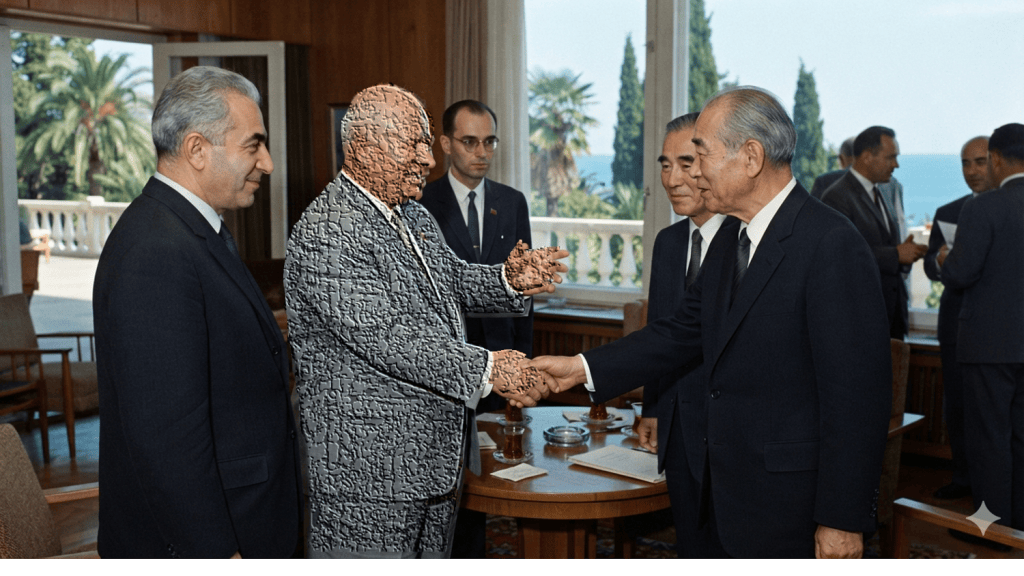
During his October 1964 vacation in Sochi, Soviet Premier Nikita Khrushchev held a notable meeting with a visiting Japanese parliamentary delegation that ultimately became one of his very last diplomatic acts before being overthrown. While a similar meeting in September 1964 saw Khrushchev aggressively issuing nuclear warnings against China to a Japanese cohort, the October meeting in Sochi served a completely different historical purpose: it provided the perfect smokescreen for the palace coup happening behind his back in Moscow.
The unwitting Japanese delegation (headed by Aiichiro Fujiyama, with an entourage that included Saiji Hasekawa, Kitsuju Ayabe, and Takeso Shimoda, and an unidentified number of others) had traveled extensively across the USSR, coming away impressed at the marvels of technology and cheer that they were allowed to view, gushed over Khrushchev (who himself was joined by his trusted colleagues Anastas Mikoyan and Vladimir Lebedev). Khrushchev, in turn, appeared lighthearted and without his trademark bluster in front of formal representatives of capitalist nations.
During the two and a half hour conversation (the lengthy transcript of which has been translated and provided below), Fujiyama and Khrushchev discussed a number of topics, including the repatriation of Japanese citizens unable to depart the Soviet Union due to strict emigration policies, as well as the return of Japanese prisoners of war who had been missing for almost twenty years at the time. Another topic of concern to both parties was China, its continued technological expansion, and the probability that it would soon be nuclear capable. Fujiyama and company also had a number of questions regarding Khrushchev’s opinion on the growth of the UN Security Council and potential issues with the UN Charter. Khrushchev appeared to be able to deftly accommodate all of the questions with genial aplomb. Indeed, several times during the meeting, the transcriber noted the appreciative Japanese delegation freely laughing at Khrushchev’s humorous asides. At other times, however, Levedev and Mikoyan had to step in to seemingly steer Khrushchev away from sensitive (possibly classified) subjects.
What none of the participants knew at the time was that the meeting was allowed to take place primarily to quell rumors that Khrushchev was in the crosshairs of a number of powerful Moscow politicians, not least of which was Leonid Brezhnev, who would (surprise!) take over Khrushchev’s newly available post after the coup was complete.
The following lengthy transcript of the meeting with the Japanese reflects the relaxed atmosphere, but more importantly, a curiously strong Khrushchev, providing detailed and unambiguous answers to sometimes difficult questions.

Unedited transcript of a conversation between N.S. Khrushchev and A.I. Mikoyan and members of the Japanese parliamentary delegation
3 October 1964
Nikita KHRUSHCHEV: I welcome you to the shores of the Black Sea, to the land of the Georgian Republic—or, more precisely, to the land of the Abkhaz people, the Abkhaz Republic, which is part of the Georgian federation.
Aiichiro FUJIYAMA: Allow me to express my deep gratitude for the fact that you have received us here today, on the shores of the Black Sea, and, as you just mentioned, in the Georgian Republic. But above all, allow me to thank you for receiving us, in spite of the fact that you are currently on vacation, and for graciously showing us your beautiful dacha with such openness. I thank you once again for this.
I would also like to express, from the bottom of my heart and on behalf of all five members of parliament who have just toured your country, our deep gratitude for the attention shown to us during this trip by the Supreme Soviet and the Soviet government, including the assignment of a senior representative of the Supreme Soviet to accompany us, and for the tremendous assistance provided to us, even though the trip itself was of a personal nature.
We are most pleased to report that during our tour of your country, we familiarized ourselves with construction projects in Siberia, specifically in Western and Eastern Siberia. We visited Irkutsk and Bratsk and learned of the great attention the Soviet government has been devoting to the development of Siberia; at the Novosibirsk branch of the Academy of Sciences, we learned about the immense prospects for the region’s further development. We subsequently visited Tashkent, Kyiv, and Leningrad before returning to Moscow.
We had initially assumed that twelve days would be sufficient to see the Soviet Union’s most important cities, but during the trip, we realized that this was, of course, not enough. Nevertheless, thanks to the assistance we received, we managed to see the highlights, despite the limited time. I am most pleased to report this to you.
And wherever we went, we witnessed massive, intensive construction activity. Roads and new cities are being built. New factories are springing up in Siberia. It became clear to us that such massive construction would be impossible without a policy of peaceful coexistence.
In Japan, we have recently grown accustomed to seeing a construction boom driven by the upcoming Olympic Games. We witnessed a similarly intense pace of construction, with building sites everywhere we went. This gave us the firm conviction that the Soviet Union is rapidly expanding its economic strength and will soon attain colossal economic power. Indeed, the reality of what we saw, and what we had previously known about the Soviet Union back in Japan, turned out to be quite different from what we had imagined. The Japanese saying holds true: seeing once is better than hearing a hundred times.
As I have already mentioned, this trip is of a personal nature, so I did not intend to raise any major new issues for discussion. However, I would like to bring the following matter to your attention.
I serve as chairman of the committee for non-repatriated persons. This is an inter-parliamentary commission that includes various Japanese public figures, and the chairman of its executive board is Mr. Hasegawa, a Member of Parliament who is present here today. He has already been in contact with the chairman of the Soviet Red Cross regarding this issue. The matter has also been raised through the Ministry of Foreign Affairs. For my part, without going into detail, I simply ask for your assistance and for a sympathetic approach when considering issues related to repatriation.
I formerly served as Minister of Foreign Affairs, and for that reason, both then and now, I have maintained an interest in various issues concerning the international situation. I have also heard about your proposal to establish a permanent UN armed force. I believe that if one adheres to a policy of peaceful coexistence, the United Nations takes on even greater importance. During my time as Foreign Minister, I pursued a policy of centering everything around the United Nations.
I would like to use this meeting not to argue, but simply to exchange views and hear your opinion on this matter, which would be of great help to me in the future.
KHRUSHCHEV: So, can I answer, or are there additional questions?
FUJIYAMA: This is not so much a specific question, but we would very much like to know your views on these matters. For instance, when the United Nations was established, there were initially 42 member states; now there are 120. The scope and very nature of the UN’s activities have expanded.
We have doubts as to whether the current composition of the Security Council is adequate. Furthermore, the UN Charter provides for the possibility of a review after ten years. The Charter also contains language designating Japan and Germany as “enemy states.”
We have also heard, in various speeches and statements of yours, a number of proposals regarding the reorganization of the UN apparatus (what we refer to as the “troika” system) and the creation of a standing UN armed force. However, these points were raised in isolated speeches or statements.
We would now like to hear your views once again on these aspects as a whole.
KHRUSHCHEV: Very well, I will answer the questions put to me in order.
Regarding individuals of Japanese descent who wish to relocate to Japan: this is a straightforward matter; should we identify such individuals who desire to leave, they may do so at any time without delay.
FUJIYAMA: We would ask that, if at all possible, you could expedite the processing of these matters.
KHRUSHCHEV: Very well. I actually haven’t received any information about individuals currently here who wish to leave for Japan on the grounds of Japanese descent. But if there are such people, I repeat, we will enable them to leave without delay.
FUJIYAMA: Since this is a specific matter, we have already contacted the relevant organizations. You will likely be briefed on this. And since the subject has come up, allow me to make one more request: could consideration be given to permitting visits to a specific cemetery on Sakhalin next August?
KHRUSHCHEV: I promise and assure you that we can do this; you can count on it and make the appropriate announcement. Whether in one location or several, there will be no difficulties. I have already been told that you are interested in cemeteries on Sakhalin. That is possible. And then, in Alma-Ata…
FUJIYAMA: In addition, I would like to take this opportunity to express our deep gratitude. We were all deeply moved to see that the Japanese cemeteries we visited, such as those in Irkutsk and Tashkent, are well-maintained, and that mayors and relevant authorities in every city are providing every possible form of assistance. We are most grateful for this.
Along these lines, I have one further request regarding this matter. There are currently a number of Japanese individuals — formerly prisoners of war — listed as missing in the records we handed over to the Soviet side; more than twenty years have passed since the war ended, yet their relatives still do not know their fate. We have a request concerning this. A range of legal issues arises — for instance, regarding divorce and inheritance — and, moreover, wives, children, and parents need to know the ultimate fate of these individuals. Therefore, we would ask for an official response regarding the list submitted to the Soviet side which states, for example, that a specific person died and was buried in a particular location, or that nothing is known about another person’s fate. Such formulations would be entirely satisfactory to the Japanese side; we would ask that you arrange for these inquiries to be conducted and the results reported to us by June 1965, thereby resolving all outstanding questions related to this matter.
KHRUSHCHEV: I fully understand the issue you have raised and the concerns of the victims’ relatives. And I promise to do everything just as you wish.
When you arrive, tell the Foreign Ministry to prepare that information.
[Saiji] HASEGAWA: Allow me to thank you — as I handle precisely these matters in parliament — for the goodwill you have shown regarding all of Mr. Fujiyama’s requests.
Regarding repatriation, Your Excellency stated that if there are individuals who wish to leave, the opportunity to do so will be granted to them. Once the necessary formalities are completed, the repatriation of all these persons could be carried out simultaneously, and the Japanese side could dispatch a ship to meet them.
KHRUSHCHEV: That is true, but here is what I question: this matter has already been looked into, and the lists submitted to us may include names of people we know nothing about, people we do not actually have in our custody. That is where the difficulty lies. You believe we have them; you are not the only one who thinks so. We face the same issue regarding West Germany and Italy. We do not have these individuals, yet they are listed as being in our country.
But I am speaking of people who are actually here, Japanese nationals, and who wish to return to Japan. That is the general situation. However, I tell you right now: we do not have such people.
I had a son, a pilot and an officer. He, too, is currently listed as missing in action because he flew a combat mission — he was a fighter pilot and he never returned. I am not searching for him because I am convinced he perished. Yet, legally speaking, I would also have the right to demand that Germany account for my son, claiming he might be a prisoner of war.
So, a great many people have died, and we have a category for those who are missing in action and have no known grave. We have hundreds of thousands of such people.
FUJIYAMA: I am once again very grateful to you for your kind-hearted approach to this matter. This is a specific issue, and the relevant authorities can work out the details. All I ask is for the same goodwill on your part in resolving the entire range of these issues.
KHRUSHCHEV: We will do that. It is indeed the right thing to do; your country has specific legal requirements regarding inheritance, divorce, and the like, so you do need the kind of statements you mentioned. They must be provided, and we will provide them. If the person is alive, we will report that; if he has died, we will report his death; if we have no record of him, we will state that we have no information and no record of him. Those are the three possible responses.
FUJIYAMA: We are very grateful.
KHRUSHCHEV: Now, the second question concerns the UN. Of course, I cannot outline my position on the ideal organizational structure right now, as that is a matter requiring specialized preparation, but it is indisputable that the existing structure is outdated and fails to reflect the current situation and global conditions. Therefore, we ought to give some thought to the structure.
Indeed, there used to be 42 states there, whereas there are now 120. However, I view this not merely in terms of numbers, but also in terms of quality or, one could say, the socio-political phenomenon that actually exists in the world today.
In fact, when the United Nations was established, the Soviet Union was the only socialist country. Mongolia existed too, but it was not taken into account; indeed, no one recognized it back then except the Soviet Union. Now, there are 13 or 14 socialist countries; furthermore, the socialist sector has acquired considerable weight—not just numerically, but also in terms of population (around a billion people) and economic power.
In short, all of this needs to be taken into account somehow, yet currently, it is not reflected at all.
That is why I proposed that the Security Council should represent the three sectors that have emerged in the world: the capitalist sector, the intermediate sector (comprising the newly liberated African, Asian, and Latin American nations), and the socialist sector. After all, peace and peaceful coexistence within the current global economic and political structure can only be ensured if all three of these sectors are equally represented on the Security Council. For if one of these three were to dominate, peaceful coexistence would be impossible. Up to this point, the United States has held the lead, and done so quite arbitrarily. They do not recognize China. One might refuse to recognize China, but China exists. One might refuse to recognize the moon or the sun, but they exist. [Laughter] If you close your eyes and do not see the moon, that does not mean it isn’t there; it simply means you do not see it.
All countries that exist and possess statehood ought to be in the UN unconditionally. Clearly, both Germanys and China should be represented. I cannot speak for Korea and Vietnam, that is their affair, but it seems that, in reality, two countries exist there as well.
A very interesting situation is brewing right now. The Americans, and those who support their policy, are threatening to expel us and strip us of our voting rights in the UN because we are not paying the funds spent on maintaining UN troops. We will not pay, no matter the threats; for even if we are expelled, it is impossible to expel us from the face of the Earth. [Laughter] It’s absurd. So, who benefits if we are expelled? Well, our people will simply come home, and we will thereby cut the costs of their upkeep. I do not know who stands to gain from that.
Why do we refuse to pay? The sum is small. It’s not economic hardship that drives us to this. Rather, these are expenses incurred illegally. The Charter states that the Security Council decides matters of national security, war, and peace, and we have a permanent representative there. We voted against the move; the decision was made not by the Security Council, but by the Americans. Yet, under the Charter, they have no right to make such decisions. There is a saying in the capitalist world: “He who pays the piper calls the tune.” We did not call this tune, and therefore we will not pay. [Lively stir in the room] America called the tune, yet we are expected to pay?! They sent troops to the UAR, to the border between Israel and the UAR. Why were troops sent there? They were sent after Britain, France, and Israel attacked Egypt. Let France, Britain, and Israel pay. Why should we pay? We haven’t paid, and we won’t pay.
Troops were sent to the Congo. Why were troops sent to the Congo? Because the Belgians did not want to leave the Congo. Lumumba asked the UN for troops. Those troops were sent there, and Lumumba was killed. And we are supposed to pay? They shouldn’t have meddled there in the first place. Now America is there, and we are supposed to pay?!
No, that is an old policy; it has failed. Therefore, we will not pay for that old policy — old in terms of both time and ideas.
We support the creation of United Nations forces and an amendment to the Charter.
We are mature, experienced people who understand who represents whom. You represent capitalist Japan, the capitalist world. while I represent a socialist country and the socialist world. So, if you and I were to create United Nations armed forces, and you said, “Well, Khrushchev, let’s agree to establish a joint UN military force,” while thinking to yourself, “Fine, if he agrees and puts up the money for maintenance, we — the capitalist sector — would control the troops.” … And I, for my part, might say, “Well, I’ve spoken with the Japanese; they agree to a joint force and will provide the funding, but our man will be the commander, and we’ll use the troops for our interests.” Meanwhile, Africans, Asians, and Latin Americans have their own point of view, a third one. If that’s the case, we won’t be able to create any armed forces at all. Armed forces can only be created if there are equal rights and equal opportunities within the UN for all three of the world’s existing socio-political systems.
People might object: “But look at what Khrushchev is saying! He’s the one who will keep exercising the veto.” True; if those two try to push through a decision, colluding against me alone, I will exercise my veto. But if we Communists were to collude against the capitalist countries, you would exercise your veto, too. That’s perfectly understandable.
Therefore, we need to create conditions where, in instances requiring unity, where a consensus exists that certain measures must be taken, that we vote in favor and contribute the necessary funds. Let me give you a concrete example. When France, Britain, and Israel attacked the UAR, Eisenhower condemned the action, yet the French, British, and Israelis continued the war against the Arabs. At that time, we approached Eisenhower and stated that we were willing to join forces with the U.S. under the UN flag to take action against the French, British, and Israelis. Eisenhower said at the time: “How could we possibly join the Soviet Union to take a stand against the British?! But if the British join forces with the French and Israel against the Arabs, is that even possible?”
Therefore, I reiterate that a viable UN can be created only if there are equal opportunities for the three forces that have emerged and exist in the world. We do not demand the chairmanship for ourselves, i.e., for the Communists. But neither will we grant the chairmanship to you capitalists. Nor shall we, you and I together, grant the chairmanship to the intermediate forces.
Everyone must have equal conditions. People say this is impossible. If it is impossible — and I see that, indeed, it is impossible right now — then we will be left with a feeble UN like the one we have today.
That is the reality of the situation.
FUJIYAMA: We have gained a great deal of insight from our conversation with you. I do not intend to argue right now, but I have formed the following impression: if we were to approach UN representation based on three sectors — the socialist sector, the capitalist sector, and the sector of intermediate countries — and add the right of veto to the mix, the United Nations would become a venue for constant disputes where no issue could be successfully resolved. Perhaps, in order to preserve world peace, we should seek other paths, perhaps adopting a stance of humanity and a quest for peace, while setting aside these political concepts. I really do not intend to argue, but that is the impression I have formed.
KHRUSHCHEV: The most sensible course is for you, the capitalist world, to entrust your fate to us. We believe the Communist doctrine is the most humane. We will pursue a policy in the interests of all the peoples of the world—that is the most humane approach. [Laughter]
I understand why you are laughing. But if you were to tell me the opposite, saying, “Trust us, the capitalist world; we will handle everything exactly as needed to ensure peace,” well, we would be the ones roaring with laughter. [Laughter]
That is why I base my position on reality. You won’t believe us, and we don’t expect you to, just as we won’t entrust our fate to you.
Therefore, if you, the capitalist countries, reach an agreement with the intermediate countries on a unified policy regarding some issue, and we disagree, it implies you intend to act to the detriment of us, the socialist countries.
Imagine a situation where an issue is being discussed: you, the representatives of capitalist countries, reach an agreement with a representative of the intermediate countries, while we disagree and lack the right of veto. You would say: “We have made the decision, so it must be implemented.”
And we would say: “We are opposed.”
“There are two of us and only one of you; we have armies.”
But that means war, because we would then no longer rely on the UN, but on our own country’s armed forces.
The veto serves as an alternative to war. A veto is better than war. A veto signifies that a particular issue is unacceptable to one of the parties, meaning it should not be pursued.
If it were pursued, the aggrieved party would be forced to resort to its own armed forces.
In short, the United Nations is not an intergovernmental government; it is a representative body for all countries and peoples, a forum where they discuss, debate, and adopt decisions intended to satisfy everyone. And if a decision does not satisfy everyone, it is better not to adopt it.
When we in government make a decision and the minority disagrees, we say that the minority must defer to the majority.
That is correct; that is the law. But in the United Nations, majority rule does not apply; there, everyone is equal. A small state and a large state – China and Luxembourg, or Iceland (Iceland is a state with a population of 120,000, but it is a state) – each has one vote. The Japanese have one vote, and we have one vote.
FUJIYAMA: But looking at it from that perspective, doesn’t the fact that only five states hold the right of veto violate that principle?
KHRUSHCHEV: I will tell you what this means. Back then, when the Charter was being adopted, it was the right approach. Аfter all, it was 1946; the war had just ended, and there were victors and the vanquished. It was the victors who drafted and created the Charter. Japan was in ruins, Germany was in ruins, and Italy was in ruins. The only powers to emerge from that war with real strength were America and the Soviet Union, along with our allies, Britain and France, though even they lacked true power. Evidently, the authors of the Charter believed at the time that this situation would endure for years and that the alliances forged during the war, the coalition that fought against Germany, Japan, and Italy, would remain intact for the future. Twenty years have passed, and everything has changed. Former allies have become practically enemies. Former enemies who fought one another have become friends. Just how sincere that friendship is… well, at any rate, it is out there for all to see. Japan and America have become allies, yet they once fought a war. The Japanese wanted to destroy America, and America wanted to destroy Japan. [Lively stir among the Japanese delegation] And now you embrace, and you fear losing that embrace. Though it is doubtful these are embraces born of love; they are embraces born of calculation. [Lively stir] Each partner in the embrace wants to strangle the other. [Lively stir] To squeeze them tight—with great love. [Lively stir]
That is the reality. And, of course, we must build anew. Japan must take its place, no longer as a country subject to discrimination, but as an equal partner. And now there are two Germanys: you prefer the West, while I prefer the East. That is a matter of preference. Some love blondes, others brunettes. [Laughter] Tastes differ. But there are two blocs, so we must reckon with the actual reality.
That is why I agree with you that the Charter needs to be revised. The Security Council also needs to be reviewed and expanded. The Security Council must reflect all three actually existing state formations on the globe. And these three formations have emerged quite clearly. Furthermore, the Security Council must not be able to adopt decisions where two formations unite against the third.
If you were to reach an agreement with the intermediate countries against the communists, and I know that would suit you better, then just consider: what if we communists reached an agreement with the intermediate countries? What position would you find yourselves in? If we reached an agreement and adopted a decision detrimental to capitalist states — and that is possible — you certainly wouldn’t submit to that decision. And what would that mean, if it were carried out? It would mean war.
But this body was created for peace, not for war. It is not an international military headquarters, after all. Therefore, the three forces must have equal rights here, and there must be a veto. Without a veto, it’s a dead end; it’s war. A veto is better than war.
That is the best I could do, speaking off the cuff, to answer your questions. Of course, I have outlined my understanding only in general terms. But there can be no other solution. We will not entrust the fate of our country to anyone, and neither will you. And rightly so. You will have to live in a capitalist Japan, and we in a socialist country. Consequently, we must respect each other’s borders and mutually respect our neighboring states. And this is expressed by not interfering in internal affairs. The affairs of the Japanese state concern Japan and the Japanese people, not Russians or Chinese, and vice versa. So, we will resolve our internal issues without Japan’s involvement.
That is how we see it.
FUJIYAMA: This is, of course, a joke, and I emphasize that it is only a joke. But it has been suggested that the Soviet Union is a vast country; what if you gathered all the communists from around the world here? You would gain a larger workforce, and there would be peace—both here and throughout the world.
KHRUSHCHEV: That’s true; that’s a good joke. But, for one thing, we have plenty of our own workforce and don’t need more labor. And besides, not all Communists would want to come here. After all, African Communists, for instance, go around in their underpants, whereas it gets pretty cold here in winter, and their backsides might freeze off. [Laughter]
[VOICE]: Japanese Communists regard the Soviet Union as their ideal.
KHRUSHCHEV: That is fine. However, what they regard as the ideal is not the Soviet Union itself, but the Soviet system. These are different things. They would like to have that system in Japan. We have no objection to that, but it is a matter for the Japanese communists. If you want to do it, do it; if not, don’t.
Kitsuju AYABE: Mr. Khrushchev says that the three forces should be represented on an equal footing. But these three forces differ in terms of state and economic power. How, then, can they be represented?
KHRUSHCHEV: Let me give you an example: consider states such as the Soviet Union, Japan, the United States, Luxembourg, and Iceland. When we vote, each has a single vote. That in itself constitutes democracy. In this specific instance, since these are independent states, the arrangement represents a recognition and respect for their independence.
If we look at it this way: the most powerful countries right now are the United States and the Soviet Union. But we maintain that power is not the same as right. We want to secure rights for these three forces. Yet these are not merely three forces but three distinct formations, and a formation is not the same as a “force” in the conventional sense. After all, what kind of power do African countries wield? Strictly speaking, they possess no power as we understand the term. Yet they do have specific interests. They are not socialist countries; they take offense when we label them capitalist. They say, “We will follow our own path.” And let them follow their own path.
Consequently, it is necessary for these formations to possess the strength to reflect the interests of these states.
FUJIYAMA: I believe it is quite possible for capitalist countries to reach a consensus with representatives of socialist countries on certain issues or regarding specific geographic regions, and vice versa. Such a convergence of positions is possible; perhaps we shouldn’t draw such a rigid line of separation?
KHRUSHCHEV: Regional agreements are possible. After all, it is not a Great Wall of China acting as a barrier. Even the Great Wall of China is no longer the Great Wall of China these days. But I maintain that these states have specific interests, and they are currently striving to have their own representatives. And rightly so.
Bear in mind that history is evolving; within a few years, we, the Communists and representatives of socialist countries, might well join forces with these newly emerged states.
America’s leadership is in serious decline. The time is not far off when America will find itself in the minority; it will take our place, while we, together with these countries, will take its place. And where do you stand? If you are with us, you will be in the majority; if with America, then in the minority. [Lively stir]
Make sure you don’t miscalculate. [Lively stir]
FUJIYAMA: Calculations are one thing, but I want efforts to be made as soon as possible to achieve peace.
KHRUSHCHEV: That is our hope.
Anastas Ivanovich Mikoyan is due to arrive here shortly. Please give him a call; if he has arrived, tell him that some “real Japanese” are waiting for our “Soviet Japanese” to join the gathering. [Cheerful stir] And we would like to ask for a cup of coffee and a small glass of cognac each. Any objections? [Cheerful stir] Please call Anastas Ivanovich; he was scheduled to land in Adler at 2:40. He has come here for a three-week vacation.
You speak of peace. That is correct. We, too, desire peace, and we shape our policy accordingly. As you traveled here, you saw how much our people are building, building with incredible enthusiasm, with a great spirit of construction.
Things are going very well for us. It appears we will exceed the targets of the Seven-Year Plan by 40 to 43 billion [rubles]. We are already beginning to draft the next plan. An internal discussion is currently underway as to whether it should be a five-year plan — covering 1965–1970 — or a seven- or eight-year plan; there is also a view that it should cover ten years. We have moved from drafting annual plans to two-year plans; perhaps the time has come to draft a ten-year plan rather than a five-year one. This matter is currently being studied. All in all, our prospects are excellent. You have likely sensed this yourselves.
We are now placing the individual at the center of our attention. We have already accomplished the task of industrializing the country and have resolved our defense needs. Our industry is fully capable of meeting the people’s demands. Consequently, the further development of heavy industry will now play a subordinate role. The development of heavy industry must meet the needs of industrial and machine-building growth to ensure the production and reproduction of both capital goods and consumer goods. Of course, we will continue to develop heavy industry, but the aim is to support the expansion of consumer goods production.
The task regarding food supplies, I would say, will be resolved by 1970. We need to expand mineral fertilizer production to a level of 70 to 80 million tons. We have already set a target of 80 million, the maximum figure. But why do I say 70 to 80? Because, in all likelihood, we will not need the full 80 million.
Take America, for example. America produces 35 or 36 million tons of mineral fertilizers. America has a population of 190 million, whereas we have 220 million. Yet they produce 36 million, while we are planning for 80 million. We do not need that much.
It is possible that 70 million will suffice. But we adopted the maximum figure, accounting for both domestic needs and potential exports. Once that is done, we will resolve the issue of grain and livestock product supplies.
VLADIMIR SEMENOVICH LEBEDEV: Anastas Ivanovich has already arrived. They are asking: may they serve coffee?
KHRUSHCHEV: How do you take your coffee, with milk or cognac? It’s your choice. We have full democracy here; no vetoes. [Laughter]
That is the situation. It costs us 10.5 billion rubles. We purchased equipment from you, chemical equipment for a urea production plant, and the Netherlands supplied us with several plants. However, there is a difference of opinion: some say Japanese equipment is better, while others argue in favor of the Dutch. Japan certainly produces excellent equipment. So, we are ready to cooperate with you in this field and expand economic ties. You have interesting chemical equipment. Then there is wood-chemical equipment; currently, the Swedes and Finns are our main suppliers in that area. I am not familiar with Japanese equipment from that arena, though I assume it is good.
[UNIDENTIFIED DELEGATION MEMBER]: Japan is ready to supply such equipment.
KHRUSHCHEV: Well then, if there are such proposals…
FUJIYAMA: In terms of equipment and outfitting, Japanese factories have now reached a world-class level; therefore, the possibility of poor quality is completely ruled out.
KHRUSHCHEV: I think so too. But it’s a question of pricing. If you agree to lend to us, then we can buy from you. If you can’t, then we can’t buy from you. Then, if we give you orders, you have to buy something from us. We can offer you oil, we can offer you timber, we can offer you pulp. I don’t know, what are you interested in? We have a lot you could buy from us. Then, if there are special orders, then we can plan for delivery while these industries evolve. We have great potential.
If you can’t, then, of course, we will still fulfill our plans. There are those in the capitalist world who say: we won’t give loans, we won’t help the communists. Well, that’s your business. When you give loans, you charge us interest.
So I don’t know who helps whom more. These are merely economic transactions; they can only exist when they are mutually beneficial.
FUJIYAMA: In the Soviet Union, the impression sometimes arises that Japan withholds loans due to pressure from the United States. This is not entirely accurate. First, the Soviet Union is a country with immense purchasing power; consequently, Japanese business circles sometimes feel a distinct urge to engage, reasoning that since the Soviet Union is capable of paying, it is worth a try. This is underscored by the fact that Japan is compelled to extend loans to certain Southeast Asian nations that genuinely lack the means to repay them. Furthermore, trade with the Soviet Union is also envisioned in terms of direct exchange. On the other hand, one could also reason that, given the Soviet Union’s high creditworthiness, there is every reason to extend loans to it.
KHRUSHCHEV: You are my guest, so I cannot say that you are speaking untruthfully; instead, I will put it this way: your reasoning is not entirely accurate. [Lively stir] I ask you, when you arrive in Tokyo, to visit the Japanese Ministry of Foreign Affairs, where you once served as minister, and find out whether there were indeed documents exerting pressure on the Japanese government to intervene and scuttle the deal to supply large-diameter pipes to the Soviet Union; then you will see for yourself whether I am telling the truth or you are. [Lively stir] I am referring you to your ministry, not ours.
FUJIYAMA: Indeed, such cases could have occurred, but one cannot apply that approach to everything.
KHRUSHCHEV: This is not a matter for discussion right now; it’s pointless. We have a saying: Everyone goes mad in their own way. [Laughter]
FUJIYAMA: I’d like to have a cigarette, but I know you don’t smoke. Do you mind?
KHRUSHCHEV: I don’t smoke. But there is plenty of air here—a whole green ocean. If you don’t care about your health, go ahead and smoke.
AYABE: Given the opportunity to meet with the world’s greatest leader, I would like to ask a question: how do you view this issue? There are 127 states across the globe with a total population of 3.5 billion; of these, roughly one billion lead a more or less tolerable existence, while 2.5 billion live in very dire conditions, on the brink of destitution. Naturally, they are struggling to improve their living conditions. The Soviet Union and the United States are the dominant players regarding this issue. What is your perspective, and what paths do you see for resolving this problem? This question frequently arises in Japan.
KHRUSHCHEV: This issue was discussed and linked to the question of disarmament, with the aim of diverting the 10% currently spent on armaments into a fund to aid underdeveloped countries. That is a very large sum, and it would constitute very real, concrete assistance. We need to boost the economies of these countries. We are currently doing some work to this end on an individual basis. We have built, and are currently building, many factories in India using credit arrangements. We are building the Aswan Dam in the UAR. The Prime Minister of the UAR was just here, and we concluded an agreement to supply agricultural machinery. This machinery will enable them to bring thousands of hectares of new land under cultivation. We are providing this on quite favorable terms. Once Egypt carries this out, it will stand on its own two feet and become a country that not only meets its own needs but may even be able to export. We help a great many others. We helped China. We built a tractor plant, an automobile plant, a metallurgical plant, and military factories there. Relations are strained now, but there was a time when the Chinese greatly valued our help, and in time, they will value it again. We are mortal, and there will be intelligent people after us, too. Stalin used to say, “When I die, you will perish.” He died, yet we are living even better. And some people say, “If only Stalin had died sooner, we would be living even better still.” [Laughter] I think they might be right.
FUJIYAMA: I would like to express my own views on the issue of providing aid to underdeveloped countries. Such aid is currently being provided by both the Soviet Union and the United States. I am not referring to aid in the energy sector, although I do consider it essential. But there is another very important issue: employment. Therefore, it might be advisable to provide assistance, addressing both financing and technical needs, to help people establish small and medium-sized enterprises, such as those producing tableware and the like, in order to employ as many people as possible. It seems to me that this aspect is currently somewhat underestimated. Large factories with automated lines are being built, yet it is uncertain whether they will actually operate, given the very low, backward level of technology. I believe we should not underestimate this aspect — that is, providing aid to these countries for the creation of small and medium-sized enterprises.
KHRUSHCHEV: Well, for instance, we built a number of plants in India; our specialists were there, and they trained the Indians.
And here is Anastas Ivanovich Mikoyan — “your Japanese man.” [Applause]
Will you sit among “your Japanese,” or will you sit with us? Or haven’t you decided yet?
MIKOYAN: They might not want me; I’ll sit with you. [Laughter]
KHRUSHCHEV: I haven’t fully answered yet, and you might think I’m dodging the question. There is one point you raised that I haven’t addressed: specifically, your remark about there being only five permanent members [of the UN Security Council].
What is the reason for these five? They are the largest and most powerful states. Consequently, since these five will not adopt any decisions directed against one of their own number, a major war cannot break out.
That is why these five were granted the right of veto. That was the right approach. And it remains right today. After all, if Luxembourg, for instance, disagrees with a UN decision, a world war won’t ensue. But if the United States disagrees and we try to force the issue, there will be war. Conversely, if America and the others adopt a decision against us and try to compel us to comply, that too means war. So, that decision was correct. Now, however, it likely needs to be reconsidered and expanded. We perhaps need to take into account that India, Japan, and Germany are major nations today. And China. Although China was represented, it wasn’t the right China; it should be the People’s Republic of China, as it is a significant power today.
That is our point of view. [Turning to A.I. Mikoyan] As for your “Japanese” view, I don’t know. [Laughter and animated chatter]
FUJIYAMA: We are very pleased that Mr. Khrushchev has expressed the view that, should the Security Council be expanded, Japan might expect to be represented there. We are very happy about this statement by Mr. Khrushchev. I do not wish, as the saying goes, to hold you to your word, not in that sense; rather, the mere fact that you think this way gives us great satisfaction and pleasure.
MIKOYAN: Does Japan participate as a permanent member or as an elected member?
FUJIYAMA: What I mean is that if a decision is made to expand the composition of the Security Council, thereby increasing the total number of its members, then the question of increasing the number of permanent members will likely arise as well. In this regard, we are pleased that you have named countries such as India, Germany, and Japan among the states that could lay claim to a permanent seat.
KHRUSHCHEV: Indonesia, Pakistan…
FUJIYAMA: There are many candidates; a selection will have to be made.
KHRUSHCHEV: The two Germanys. [Addressing Mikoyan] You weren’t there for this part; the question was raised of the Security Council having armed forces at its disposal. I spoke of three forces, three groupings, and it makes no difference to me whether they are permanent or non-permanent. Whether they are permanent or non-permanent matters little now. The main thing is that the interests of all three of these forces — or rather, not forces, but groupings — must be taken into account. That is the crucial point.
MIKOYAN: This is our fundamental position.
KHRUSHCHEV: That is why I argued that the situation could not be such that we would agree to a scenario where two formations might unite against a third. That is, there could be no question of a majority and a minority, but only of equal opportunities for these three formations. But, of course, Japan belongs to the capitalist formation.
FUJIYAMA: They themselves practically consider themselves Western.
KHRUSHCHEV: And they call us aggressive. [Lively amusement] [Pointing toward Mikoyan] He knows you better; he is a “Japanese” himself. [Laughter]
FUJIYAMA: I would like to touch upon one more issue. Japan has now grown sufficiently strong, both as a state and in terms of its economic development. I believe that Japan should play an active role in resolving international problems as they arise. For example, the situation in Laos. If, ten years ago, when the conference of the thirteen was convening…
KHRUSHCHEV: Fourteen.
FUJIYAMA: Fourteen countries. Back then, of course, the question did not arise; Japan could not lay claim to such a role at that time. Now, however, it seems to me that if similar issues arise in Asia in the future, Japan should hold an equal position as a member of any international commission dealing with these matters.
KHRUSHCHEV: [To Mikoyan] You weren’t here for this part; the issue was raised that the UN Charter contains a discriminatory clause against Japan, as well as Germany. Twenty years have passed, and the situation has changed. I remarked that former allies who fought side by side have now become near-enemies, while former enemies who fought against each other have become friends. Sometimes, these friends embrace one another so tightly that the strong might strangle the weak, yet outwardly, they remain friends. [Laughter]
This brings us to the question of the makeup of the Security Council. Things need to be different now. I am not saying, should the Charter be revised, exactly how it would be worded or who would be admitted as a permanent member; that is a matter requiring deeper study and resolution.
I am saying only one thing: whatever the structure may be, if it fails to recognize the equal rights of the world’s three systems, then that structure is worthless; it will lead to war.
MIKOYAN: As for Japan’s participation in the Security Council, that is a separate matter.
KHRUSHCHEV: Yes. Japan is currently a great and powerful nation.
For instance, had the UN adopted a resolution against the Soviet Union, leaving us standing alone, we would have defied them all; we would not have submitted. The fundamental issue concerns the three categories of states. Each category must have equal rights regarding its defense and the expression of its viewpoint. Two parties cannot simply make a decision against a third. In a government, a two-against-one scenario is the rule. That is how government works. In international organizations, this factor is taken into account, but it is not a binding rule.
[MIKOYAN says something indistinct to KHRUSHCHEV]
KHRUSHCHEV: That’s what I was saying. It turns out “your Japanese guy” and I have a lot in common, even though he wasn’t there when we talked. [Laughter] I didn’t expect it, but I was pleasantly surprised. [Laughter] It turns out you can come to an agreement with “the Japanese guy.” [Laughter]
Takeso SHIMODA: The discussion here is currently about China. The US Secretary of State has stated that China will conduct nuclear tests in the near future. I would like to know your opinion on this matter. Does China actually have the capabilities to do so?
KHRUSHCHEV: I believe the Chinese are capable of carrying out a nuclear explosion. In fact, we even thought they ought to have done so already. During the period of close, fraternal relations, Chinese scientists were granted access to a great deal of our classified work and saw how we went about it. However, the most important aspect of creating nuclear weapons is not merely seeing how it is done; one must have the necessary infrastructure. We provided them with the equipment for producing nuclear fuel.
MIKOYAN: We installed the plants and provided other assistance as well.
KHRUSHCHEV: So they’ve gained a great deal from us and know how to do many things. We therefore expected them to carry this out, and they will. The real difficulty, however, lies in the fact that their technical, industrial, and research-and-development base is too weak.
I can let you in on a secret. We used to exchange certain new military technologies and, thanks to our Chinese comrades, we managed to acquire an American air-to-air missile. This happened in 1958, during a skirmish in which they shot down an aircraft using our missiles. Yet, even after obtaining such an item, copying it requires a solid infrastructure. For the time being, China’s base remains weak. Oil production stands at 6 million tons, and the energy infrastructure is inadequate.
MIKOYAMA: They say they have no shortage of oil.
KHRUSHCHEV: That’s actually a bad sign if they produce six million [tons] and face no shortages; that speaks to the level of their industry. We produce 223 million and it’s just not enough. This does not mean the Chinese live better than we do; it indicates that the level is too low. But if efforts are concentrated so that, as Chen Yi put it, “we may go without trousers, but we will have the atomic bomb,” then they can achieve it. And you could create it too, if you wanted to. That is a separate matter; while there is the question of legal status, from a scientific and technical standpoint, you are capable of creating it. Japan possesses the necessary scientific and technical base.
FUJIYAMA: Although our technical conditions allow for it, we are not considering it.
KHRUSHCHEV: That is a smart move. Not because you don’t have them. Well, you will have them, right? England has them, France has them. I don’t mean to disparage anyone, but France cannot catch up with either us or the United States; its economic power simply doesn’t allow for it. England is in the same position. They do possess a certain number of them. But nowadays, the question of quantity no longer matters.
In short, if a war breaks out, we could destroy one another; we could turn each other into shashlik, only there would be no one left to eat it. [Laughter]
I recently visited a testing ground for missile trials…
MIKOYAN: Are you trying to tell them all of our secrets? [Laughter]
KHRUSHCHEV: When I spoke with Japanese parliamentarians, I had just visited a site to inspect ground-based weaponry the day before. After that, I flew to a testing range to look at missile technology — specifically, intercontinental ballistic missiles. A scientist of ours called me today; he is testing a new missile of his own.
Missiles and delivery systems for nuclear warheads are more difficult to develop than the warheads themselves. This requires an extensive R&D infrastructure. Consequently, the Chinese will face significant challenges in missile manufacturing, even though we have supplied them with surface-to-air missiles; they do possess our missiles. After all, when they shoot down American aircraft, those are our missiles. The ones we supplied to them.
However, it is better for us not to think about war, but rather about peace. We would like to develop strong economic ties with Japan. Japan possesses an excellent industrial and scientific-technical base, and its workforce is highly skilled. In short, the products are of very high quality, and we would gladly trade with you.
MIKOYAN: The Japanese are very inquisitive people; they might question you until late in the evening. [Laughter]
KHRUSHCHEV: And now you’re here, having come to my rescue. [Laughter]
I’m here to relax, but I’m also preparing a report. We have a plenary session coming up in November, and I’m the speaker. I’m working on the report here. I did some work this morning, then stopped and went for a walk. And now I’m just relaxing and having some coffee. [Laughter]
[VOICE]: Tell me, do you write the texts of your presentations yourself?
KHRUSHCHEV: Well, I dictate them.
[VOICE]: You know, we’re always amazed: you give very long presentations—lasting three to six hours. How do you prepare?
MIKOYAN: He’s exaggerating. They don’t go up to six hours.
LEBEDEV: Well, once he gave an eight hour speech.
KHRUSHCHEV: Actually, they were two reports covering two issues, a status update and the program, delivered back-to-back.
Well then, let’s drink to our friendship!
FUKIYAMA: It’s been a great pleasure to meet you here in such a beautiful setting, amidst such fresh air. We do regret, however, having interrupted your leisure time. Nevertheless, the very fact that this meeting is taking place testifies to the emergence of friendly relations between our two countries, and it will make a significant contribution to the further development of our ties.
Having traveled across your country, we realized that our previous impressions of it were in many respects different, and that we need to view it in a new light. Consequently, we are fully prepared, upon our return to Japan, to strive for the further strengthening of our friendly relations. We are delighted that, as we conclude our trip with these sentiments, we are able to meet you here in such a friendly atmosphere. This brings us great joy, and we will continue our efforts in this direction.
We Japanese deeply desire peace. That is a wish likely shared by other peoples of the world as well. Ultimately, however, issues of peace are decided by people such as yourself, Prime Minister Khrushchev, along with President Johnson and President de Gaulle. You hold the keys to peace in your hands. I would like to urge you to exert even greater effort to ensure that peace is achieved.
KHRUSHCHEV: Thank you for your kind assessment of our struggle for peace. But entrusting the keys to peace to just three people is a risky proposition. Everyone must fight for peace; only then can it be secured. If you rely on us to hold the keys to peace while you sleep and snore, war might well wake the snorers up. [Laughter] We must all fight for peace, and peace can be upheld only through joint effort. That is the toast I propose: to peace, to our efforts, and to the friendship between us!
FUKIYAMA: Then let me conclude here. Thank you.
KHRUSHCHEV: Thank you.
SHIMODA: Given the private nature of the conversation, we would suggest the following to the Chairman of the Council of Ministers: it would likely be best to refrain from publishing it and, instead, limit publication in Japan solely to the section on repatriation, a topic in which there is great interest there.
What is your view?
KHRUSHCHEV: I think that would be the right approach, because we covered a wide range of issues and shared our thoughts. If a single point were to be singled out and presented in isolation, it could end up doing harm rather than good, in short, leading to an outcome we do not want.
SHIMODA: So just the repatriation issue.
KHRUSHCHEV: Maybe even our discussion of trade.
SHIMODA: A second question. You often speak about your position regarding the UN. Could you shed some light on this matter?
KHRUSHCHEV: You could say that Khrushchev reiterated what he had previously stated and substantiated.
SHIMODA: Is it possible to single out the statement that, should an international conference on Asia take place, Japan has the right to be a candidate for participation in such international meetings addressing various issues?
KHRUSHCHEV: Perhaps you could mention that during the conversation with Khrushchev, when issues concerning Asia and the East were raised, he stated his view that Japan has a bearing on the resolution of these matters and that its participation on an equal footing with others could be beneficial.
SHIMODA: Thank you.
Conversation lasted two and a half hours.
Interpreter: L.A. STRIZHAK
Recorded by N. GAVRILOVA on 4 October 1964
RGANI. F. 52. Op. 1. D. 597. L. 115-151.

Translation © 2026 by Michael Estes and TranslatingHistory.org
 Translating History