
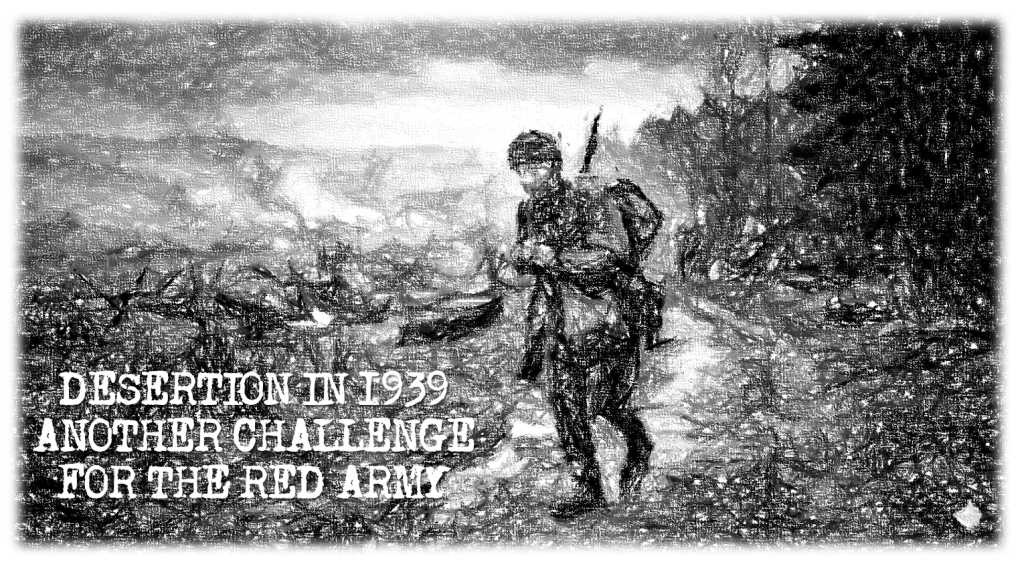
When it rains, it pours for Marshall of the Soviet Union Kliment Voroshilov. Having done little to quell insubordination and a lack of military discipline and morale in the ranks, as the year 1939 draws to a close, he is facing the very real and growing issue of desertion. As we’ll see in the following translation, however, it’s more a question of nobody in charge passing information along to the infantrymen – and that appears to be a top-down problem.
In the following declassified Top Secret report to Voroshilov from the acting Chief Military Prosecutor Pavel Filipovich Gavrilov, the latter explains that a number of the deserters were actually AWOL, having dashed off homeward to either take care of family matters or bid their families farewell until their (hopeful) return, with nobody in charge to tell them otherwise. Those in charge, as it turns out, couldn’t be bothered to take care of the basic administrative tasks of drawing up muster rolls; this became an issue when head counts turned up short (to the tune of some 700 men) with no idea of the names of the affronting parties.
This document, dated 23 December 1939, is the result of the investigation of desertion throughout one single rifle division (the 64th). One can only imagine how rampant desertion was throughout the rest of the Soviet military.

Top Secret
Prosecutor’s Office of the Union of Soviet Socialist Republics
Chief Military Prosecutor
23 December 1939
No. 32708
Moscow
TO THE PEOPLE’S COMMISSAR OF DEFENSE OF THE USSR
MARSHAL OF THE SOVIET UNION VOROSHILOV
I herewith report that the investigation into instances of mass desertion within the units of the 64th Rifle Division has established the following:
Desertion reached particularly high levels on December 13–14, that is, just as the units were being dispatched to their assigned locations: 300 men deserted from the 159th Rifle Regiment, 252 from the 30th Rifle Regiment, and 66 from the 288th Rifle Regiment.
No large-scale political work was conducted in the 159th Rifle Regiment prior to departure. The soldiers did not know where they were going or for what purpose. Consequently, they would leave to say goodbye to their relatives at home and return the following day.
A total of only six mid-level and ten junior commanders were assigned to the 719-man column, a number clearly insufficient to provide adequate command leadership. Some railcars lacked commanders entirely.
The purchase of alcoholic beverages by Red Army soldiers at the railway station reached such a point that they began filling their canteens with the liquor.
In the 30th Rifle Regiment, out of 252 deserters, 36 had failed to report by December 17. The regiment’s commander and commissar were completely unaware of the mass unauthorized absence of the troops. The contingent was accepted for transport based on a headcount rather than nominal rolls, as no such lists had been compiled.
In the 288th Rifle Regiment, 30 of the 66 deserters remained unaccounted for.
In total, 700 men deserted from the division’s units. It is currently impossible to identify the escapees due to the absence of personnel records.
During preparations for the troops’ deployment, the division’s political department failed to assign its own instructors to the units, relying instead entirely on the regimental commissars.
A lack of clear organization regarding internal guard duties within the regiments facilitated the men’s unhindered departure. The internal guard details consisted primarily of reservists who had little to no understanding of their duties.
Regimental commands made no use of Red Army comrades’ courts. In the 30th and 288th Rifle Regiments, not a single soldier was brought before a comrades’ court for unauthorized absence or other disciplinary violations. In effect, these courts had ceased to function within the units.
The handling of complaints and petitions from Red Army soldiers and their families has been extremely poor; this inevitably affected the morale of some soldiers, leading them to leave their units without authorization to attend to family matters.
The military prosecutor’s office has taken steps to identify the principal instigators and organizers of desertion, with instructions issued to apply wartime laws against them.
Regional Party and Soviet organizations have taken measures to fundamentally improve the process of reviewing complaints and petitions from Red Army soldiers and their families.
Legal education efforts within the division’s units have been stepped up.
Acting CHIEF MILITARY PROSECUTOR
DIVISION MILITARY PROSECUTOR GAVRILOV

Translation © 2026 by Michael Estes and TranslatingHistory.org

