
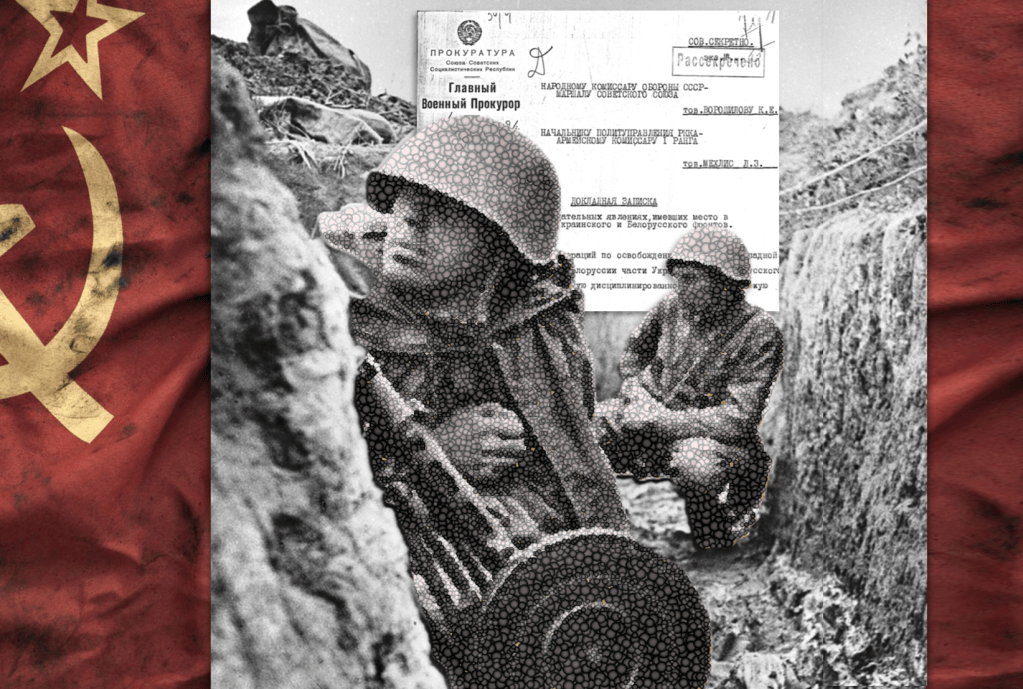
Whew. At some point, one would think Voroshilov would stop reading the incoming reports from the Ukrainian and Belorussian Fronts regarding out-of-control Red Army troops committing grievous crimes “against the backdrop of the excellent political and moral state of the units.” This time, a Top Secret report from the Office of the Chief Military Prosecutor has reached his desk, almost demanding his attention. The report, dated 10 October 1939, comes on the heels of the successful completion of the USSR’s invasion of Poland, a duty shared with Stalin’s new best friend, Nazi Germany.
The author of the report, Brigade Judge Advocate Gavrilov, applied a nice dollop of frosting on the bad news by opening the report with the sort of chest thumping of how brave the lads were while routing the Polish Army that would do any Marshal of the USSR proud. But the big “HOWEVER” comes with the very first word of the second paragraph, and doesn’t let up for eight pages. Gavrilov spells out everything that’s been going upside down under Moscow’s nose in the Ukrainian and Belorussian Fronts. Gavrilov is no fool, however; he’s quick to pepper his report with parenthetical notations to show Voroshilov that his comrades have been busy, identifying those who have already been convicted, those who have been sent off for trial, and those whose cases are still being investigated.
One thing that may be surprising for those with little knowledge of just how the Red Army rolled throughout the war (ask the Germans) was how the subject of murders and rapes committed by the soldiers is so casually dismissed, as if Gavrilov thought, “Well, better add the stuff that everyone does to make sure nothing’s left out.” It hopefully gives the reader pause.
The declassified eight-page Top Secret document is translated here, and present apparently for the first time in English. Let us know what you think.

Top Secret
Prosecutor’s Office of the Union of Soviet Socialist Republics
Chief Military Prosecutor
10 October 1939
No. 26070
Moscow
TO THE PEOPLE’S COMMISSAR OF DEFENSE OF THE USSR
MARSHAL OF THE SOVIET UNION K. Ye. VOROSHILOV
AND TO THE CHIEF OF THE POLITICAL DIRECTORATE OF THE RKKA
ARMY COMMISSAR 1st RANK L.Z. MEKHLIS
MEMORANDUM regarding negative incidents that occurred in units of the Ukrainian and Belorussian Fronts
During the operations to liberate the workers of Western Ukraine and Western Belarus, units of the Ukrainian and Belorussian Fronts demonstrated a high level of discipline, Bolshevik steadfastness, and heroism.
However, against the backdrop of the excellent political and moral state of the units, serious negative incidents and crimes occurred in isolated cases, often leading to grave consequences.
First of all, it is necessary to note certain organizational shortcomings in the operations of the supply, medical, communications, and commandant services in specific sectors.
During the deployment period, units of the 33rd and 121st Rifle Divisions of the Belorussian Front were not issued uniforms on time and were consequently delayed at the border. Subsequently, the 33rd Division was fully outfitted, whereas 853 personnel of the 121st Division remained without uniforms. Furthermore, these divisions were not provided with motor transport until September 25. The motor transport battalion that arrived on September 23 could not be utilized due to a lack of oil. The horses received were of poor quality; as a result, there were instances where troops had to haul the artillery pieces themselves, abandoning the horses and the accompanying artillery caissons in villages. An investigation is underway.
On September 23 and 24, the mechanized brigade, 10th Army, and the headquarters of the Belorussian Front faced serious fuel shortages due to transport delays and incompetence.
The movement of combat units and rear-echelon elements was often disorganized. In the area of Ternopil, for instance, artillery units and supply columns became intermingled and fragmented into separate groups, clogging the road and causing traffic jams. Traffic control services were virtually nonexistent.
There were disruptions in the supply of food and medical equipment. As of September 22, the 33rd and 121st Divisions of the Belorussian Front were supplied with only 20% of their required medical and sanitary equipment. Units of the Ukrainian Front were supplied with individual medical kits at a rate of only 55%.
In some instances, medical units and facilities failed to deploy in a timely manner or maintain contact with combat units. In Ternopil, obtaining medical assistance was nearly impossible during the first few days following its capture.
Serious shortcomings existed on the Ukrainian Front regarding the organization of provost and security. The accounting for captured materiel was poor. The situation was particularly bad regarding captured motor vehicles; as a result, these vehicles were appropriated and used by anyone who pleased. For instance, the headquarters of the 2nd Cavalry Corps had 91 vehicles in excess of its authorized allowance. In a number of instances, this led to unit commanders driving off in captured vehicles and becoming separated from their units. In Ternopil, no system was organized to account for weapons surrendered by the civilian population; although the registration of soldiers from the former Polish army had been announced, it was not actually carried out for two days; and no arrangements were made to provide meals for passing detachments.
Inadequate communications arrangements led, in certain instances, to exchanges of fire between friendly units. On the night of September 21, 1939, while on the march, two regiments of the 34th Cavalry Division (Ukrainian Front) mistook each other for the enemy at a road junction and opened fire; three men were killed and two wounded as a result.
There were two incidents of firing upon friendly aircraft (an investigation is underway).
There were several instances of exchanges of fire and indiscriminate shooting brought on by panic. For example, seven such incidents were recorded in the 3rd Army of the Belorussian Front, resulting in 18 killed and 55 wounded, as well as 31 horses killed or wounded. Panic often arose from the most trivial causes: one night, SOLOMATKIN, a battalion duty officer of the 313th Artillery Regiment, fired his revolver aimlessly. This sparked a panic that led to a firefight between units.
A grenade exploded due to mishandling by a Red Army soldier in a supply column advancing at night. This also caused panic within the ranks. The spread of rumors regarding attacks by bandit groups particularly contributed to the panic. (SOLOMATKIN was court-martialed; the other cases were handled through disciplinary measures.)
Similar events were also noted on the Ukrainian Front, albeit in smaller numbers.
In Ternopil, sporadic rifle, machine-gun, and even artillery fire repeatedly broke out, during both day- and nighttime hours. As a result, one Roman Catholic church burned down, and another was seriously damaged.
The command took no decisive measures to halt the firing. In one part of Ternopil, officers from the military prosecutor’s office intervened to stop the shooting.
On September 18, Captain VASILENKO (of the 5th Cavalry Division, Ukrainian Front), who was in charge of an escort detail transporting 28 captured soldiers and officers to the rear, deserted his post. Following his lead, the Red Army soldiers in the escort detail also scattered, followed by the prisoners. VASILENKO was subsequently convicted.
During the course of operations, there were 25 instances of battlefield desertion motivated by cowardice. The deserters included 24 Red Army soldiers and one commander.
Senior Lieutenant GORDEYEV (87th Rifle Division, Ukrainian Front) abandoned his platoon during combat and swam across a river, only to be detained by peasants in the rear. (The deserters have been apprehended, and the majority have already been convicted.)
In addition, 11 cases of self-inflicted wounds, three cases of refusal to engage the enemy with arms, and five cases of refusal to take the military oath on religious grounds were recorded. (The offenders have been convicted.)
There were several cases of robbing civilians and prisoners and misappropriation of seized property. The following are the most egregious:
On September 23, 1939, in the city of Ternopil, Lieutenant CHEREPANOV broke the lock on a private leather goods warehouse and stole patent chrome leather intended for boots. Following CHEREPANOV’s example, the men of his platoon broke into the warehouse and looted it.
In addition, CHEREPANOV stole a radio, four sets of underwear, and other items from a private home. (CHEREPANOV was convicted.)
On September 22, Junior Political Instructor MORCHUK of the 23rd Mechanized Brigade (Ukrainian Front), together with subordinates, stopped a vehicle and robbed the agitators from a local committee who were inside. (Convicted.)
On September 23, 1939, Senior Political Instructor IVANENKO, an instructor in the Political Department of the 17th Rifle Corps (Ukrainian Front), illegally seized two bolts of wool fabric, a suit, a raincoat, a camera, and other items from prisoners and the local population, and subsequently made off with them. (Convicted.)
PETROV, the Commissar of the 3rd Tank Regiment (Ukrainian Front), misappropriated 70 meters of captured blue wool fabric and 100 meters of assorted textiles. (Investigation underway.)
GENTICHEZHEV, the Political Instructor of the 6th Cavalry Division’s headquarters squadron (Belarusian Front), systematically robbed prisoners of war and the local population while en route from Novogrudok to Bialystok between September 23 and 27. At gunpoint, he seized and appropriated money and valuables from hostages. (Convicted.)
MALASHCHUK, Commander of the 94th Separate Sapper Battalion of the 4th Rifle Corps (Belorussian Front), stole various gold and silver items valued at 30,000 rubles. These items belonged to the Provisional Administration and were under MALASHCHUK’s protection. (He is being sent off for trial.)
BURYGIN, a political instructor with a rifle company of the 2nd Rifle Regiment, 50th Rifle Division (Belorussian Front), entered a shop and ordered the merchant to measure out 7 meters of “Boston” wool suiting fabric. BURYGIN did not pay for the goods, stating that he was acquiring the material for the Red Army. He left a note in the shop reading: “To the Chairman of the Jewish Bank: Please pay Citizen Shapiro 175 rubles. City Commandant, Junior Lieutenant Ivanov.” He is being sent to trial.
On the Belorussian Front, several instances were recorded in which commanders sent confiscated property to their homes by truck.
Incidents of illegal horse trading involving the civilian population also occurred there.
Furthermore, there were three cases of robbery accompanied by murder and rape.
Instances of bulk purchasing of goods by individual members of the command staff were also noted.
TKACHENKO, a division commander in the 4th Cavalry Corps, and Commissar CHESNOKOV, together with subordinate commanders, purchased a large quantity of clothing and personal items, appropriated several captured suitcases and a sum of money, loaded the goods onto a truck, and dispatched the shipment to the city of Proskurov. The vehicle was intercepted en route by the military prosecutor’s office. They were convicted.
A reserve platoon commander from the 14th Road Maintenance Regiment (Belorussian Front), ZHUKOV, purchased a large quantity of various manufactured goods.
The investigation revealed that the purchasing of goods had become widespread throughout the regiment. The regimental command — Major NAGRADOV and reserve political officer KHAVKIN, as well as the Party bureau secretary — not only failed to take measures to stop this practice but also engaged in such purchases themselves, albeit on a smaller scale. They justified their actions by citing the absence of instructions on the matter from higher headquarters. An investigation is underway.
Instances of arbitrary conduct and violations of the law have been recorded, accompanied by beatings and summary executions of detained persons and prisoners.
The military commissar of the 81st Artillery Regiment (Ukrainian Front), MINEYEV, shot 10 captured officers. (Convicted.)
Major POKORNYY (Ukrainian Front) summarily shot two refugees. (Investigation underway.)
Red Army soldier FLORUK (6th Cavalry Corps, Belorussian Front), posing as an official, orchestrated the execution of 15 people who had been detained by a local committee. (Convicted.)
Senior Lieutenant BUKANOV of the 146th Rifle Division (Ukrainian Front) shot 18 prisoners with a gun and finished off the wounded with a bayonet. (Investigation underway.)
In three instances, unlawful executions were carried out by personnel from the Special Departments (KOBERNYUK, Chief of the Special Department of the 2nd Cavalry Corps; POPOV, Chief of the Special Department of the 87th Rifle Division). In two of these cases, the executions were carried out with the knowledge of Military Prosecutor ILYICHEV and Assistant Military Prosecutor KOGAN. ILYICHEV and KOGAN have been removed from their posts. (Investigation underway.)
KOSHTKO, the chief of staff of the 72nd Rifle Division’s sapper battalion, engaged in robbing the local population alongside a group of other commanders. In the village of Zhizhava, he organized a drinking session with an estate manager and some refugees. During the drinking, a shot rang out; KOSHTKO thereupon sounded an alarm and conducted a search of the local population. He robbed four refugees and ordered them to be forcibly sent across the Romanian border.
This order was not carried out; Red Army soldiers released the refugees near the border. Upon learning of this, the Front Command ordered fire to be opened in the direction of the Romanian border, an order that was executed. (An investigation is underway.)
During the operations, there were two cases of suicide and several vehicle accidents and crashes. These incidents are being investigated.
On the Ukrainian Front, 134 individuals were committed for trial. These included 30 members of the command staff, 15 junior commanders, 58 rank-and-file personnel, and 31 civilians.
No data for the Belarusian Front has yet been gathered.
In most cases, the military prosecutor’s offices at the fronts managed to ensure the rapid investigation of crimes and instances of misconduct. Investigations were generally completed within one or two days.
Some delays occurred in cases involving command staff due to the need to obtain authorization for prosecution.
In this regard, I consider it advisable, given the combat conditions, to grant the Military Councils of the fronts the authority to sanction the prosecution of command staff personnel.
Military prosecutor’s offices reported observed shortcomings to the command and political bodies of military units and formations.
However, a serious flaw in the work of military prosecutor’s offices was that they conducted almost no preventive work within the units.
Alongside their military duties, military prosecutor’s offices actively participated—and continue to participate—in efforts to purge liberated territories of spies and provocateurs.
Military prosecutors also assist the provisional administrations and conduct extensive outreach and advocacy work among the population.
I will report separately on constructive matters.
Acting CHIEF MILITARY PROSECUTOR
BRIGADE JUDGE ADVOGATE GAVRILOV

Translation © 2026 by Michael Estes and TranslatingHistory.org
 Translating History