
We’ve stumbled onto an unknown (to us) cache of thousands of classified documents held in the archives of the Lieutenant General Kazimierz Sosnkowski Military Historical Office dealing primarily with the challenges faced by Poland brought on by the USSR (invasion, annexation, authoritarian rule, oppression, etc.) from at least 1939 to 1955. It’s a fascinating collection, and we’ve only seen the tip of the iceberg.
One set of documents we browsed through with interest was related to the 1939 Soviet invasion of Poland, which was brought about by the Molotov-Ribbentrop Pact (you know, the agreement that promised Hitler would not commit aggression against the Soviets for at least ten years; the piercing in Stalin’s lower lip from his taking the bait can still be seen in photos taken right up to Stalin’s death).
To hear the official Soviet version, their incursion into Poland was an overwhelming success. Yes, the Soviet Union achieved its primary strategic and territorial goals during the 1939 invasion of Poland, but many reports in this collection show that the operation suffered from significant logistical and organizational flaws in the Red Army.
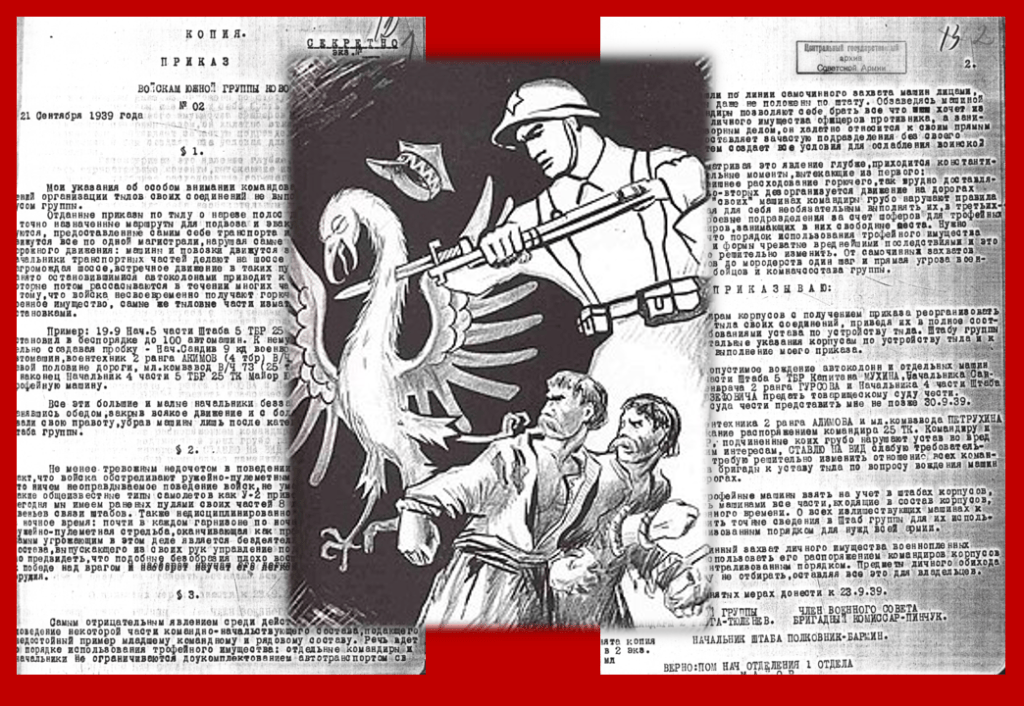
Today’s offering is an order issued on 21 September 1939 by Army Commander 2nd Rank Ivan Tyulenev, at the time the Commander of the Southern Group, to the troops of the Southern Kyiv Special Military District. In the order, Tyulenev calls out a number of individuals by name who committed gross violations of military regulations, the breach of which led to egregious breakdowns of military discipline and could have led to lives lost – not on the battlefield, but in the rear services.
Our translation of the two-page order appears to be the only online English version of the material to date. We’ll continue to delve into the Polish collection of documents and translate anything we find particularly compelling. We feel these provide a compelling backstory to a piece of history often overlooked in the shadow of the later events of World War II.
A note on the translation: The original document provides two different surnames for the Chief of the Medical Unit, 9th Cavalry Division: GURSOV and GLUSOV. We have left each variation intact, as existing documentation does not indicate which is correct.

SECRET
ORDER TO THE TROOPS OF THE SOUTHERN KO VO [KYIV SPECIAL MILITARY DISTRICT] No. 2
21 September 1939 Monastyryska
1
My directives requiring formation commanders and staffs to pay special attention to the organization of their formations’ rear services have not been carried out by a single corps in the group.
Orders regarding the allocation of rear-area zones for corps support units and the designation of specific routes for supply and evacuation are not being carried out by anyone; transport units and rear-service outfits are left to their own devices. They all crowd onto a single main road, violating the most basic traffic rules: vehicles and wagons often move two abreast, and transport commanders halt their units on the highway for three to four hours, clogging the road. Oncoming traffic encountering these stalled convoys creates bottlenecks that take hours to clear. All of this results in troops failing to receive fuel, ammunition, and other military supplies on time, while the rear-service units themselves are exhausted by these forced halts.
For example: On 19 September, the Chief of Headquarters Unit 5, 5th Tank Brigade (25th Tank Corps), Captain MUKHIN, halted up to 100 motor vehicles in a disorderly manner. Successively adding to the traffic jam were the Chief of the Medical Service of the 9th Cavalry Division, Military Physician 2nd Rank GLUSOV [sic] (37 vehicles); Military Technician 2nd Rank AKIMOV (4th Tank Battalion, Unit 5434) with 2 tanks on the left side of the road; Junior Platoon Commander PETRUKHIN (Unit 73, 25th Tank Corps) with one tank; and finally, Major YUZEFOVICH, Chief of Unit 4, 5th Tank Brigade (25th Tank Corps), with a staff car.
All these officials, high and low, stood nonchalantly on the highway, occupied with lunch and blocking all traffic; they stubbornly insisted they were in the right, moving their vehicles only after an imperative demand from the group.
2
An equally alarming shortcoming in the troops’ conduct is the fact that they fire small arms and machine guns at their own aircraft. This inexcusable behavior by troops, who fail to identify even widely known aircraft types like the U-2, has resulted in eight pilots from headquarters liaison flights being wounded by friendly fire. The troops also display a lack of discipline at night: spontaneous small-arms and machine-gun fire breaks out in almost every garrison after dark, typically resulting in one or two casualties. Most abhorrent of all is the inaction of the command staff, who are losing control over their units. It is easy to foresee that such disgraceful conduct fails to instill in the soldier the will to defeat the enemy and undermines the proper handling of weapons.
3
I consider the most egregious phenomenon among the active troops to be the conduct of certain members of the command staff, who set an unworthy example for junior commanders and rank-and-file personnel. This concerns the handling of captured property: some commanders and superiors do not limit themselves to supplementing their units’ motor transport but have resorted to the unauthorized seizure of vehicles by individuals not even entitled to them. Having acquired a vehicle, some commanders take whatever they please from the captured personal belongings of enemy officers; while engaging in such shameful activity, they neglect their direct duties, often leaving their units without leadership and thereby creating conditions that undermine military discipline.
A deeper examination of this phenomenon reveals negative consequences stemming from the initial issue: first, the excessive consumption of fuel, a resource extremely difficult to transport to the troops; second, the disruption of traffic flow, as commanders driving “their own” vehicles flagrantly violate traffic regulations, deeming themselves above the law; and third, the weakening of combat units due to the diversion of personnel to serve as drivers for captured vehicles and as passengers occupying the available seats within them. It must be stated plainly that the practices surrounding the use of captured property have reached a scale and form fraught with highly detrimental consequences, and this situation requires decisive change. There is but a single step from the unauthorized seizure of minor items to outright looting, a development that poses a direct threat to the military discipline of the Group’s rank-and-file soldiers and command staff alike.
IT IS HEREBY ORDERED:
1. Upon receipt of this order, corps commanders are to reorganize the rear-area support systems of their formations, bringing them into full compliance with the regulations governing rear-area organization. The Group Headquarters is to draft detailed instructions for the corps regarding rear-area organization and verify the execution of my order by September 23.
2. For unacceptable conduct regarding the driving of vehicle columns and individual vehicles, Captain MUKHIN (Chief of the Headquarters Unit 5, 5th Tank Brigade), Military Physician 2nd Rank GURSOV [sic] (Chief of the Medical Unit, 9th Cavalry Division), and Major YUZEFOVICH (Chief of Headquarters Unit 4, 5th Tank Brigade) are to be brought before a comrades’ court of honor. The ruling of the court of honor is to be submitted to me no later than September 30, 1939.
Disciplinary action is to be taken against Military Technician 2nd Class ALIMOV and Junior Platoon Commander PETRUKHIN by order of the 25th Tank Corps Commander. I hereby reprimand the Commander and the Commissar of the 5th Tank Brigade, whose subordinates are flagrantly violating regulations to the detriment of the army’s overall interests, for their lack of strictness; I demand a decisive change in the attitude of all the brigade’s commanders and personnel toward the regulations governing vehicle operation on military roads.
3. All captured vehicles are to be registered at corps headquarters, and all units within the corps are to be equipped with vehicles in accordance with wartime tables of organization. Precise data regarding any surplus vehicles must be submitted to Group Headquarters by September 24 so that they may be utilized in an organized manner to meet the needs of the entire army.
4. Unauthorized seizure of personal property from prisoners of war is prohibited, and its execution by order of corps commanders for units is to be centralized. Items of personal belongings, such as underwear and clothing, are not to be confiscated, leaving them for the owners.
5. Report on measures taken by September 23, 1939.
COMMANDER OF THE SOUTHERN GROUP, ARMY COMMANDER 2nd RANK TYULENEV
MEMBER OF THE MILITARY COUNCIL, BRIGADE COMMISSAR PINCHUK
CHIEF OF STAFF COLONEL BARMIN

Translation © 2026 by Michael Estes and TranslatingHistory.org

